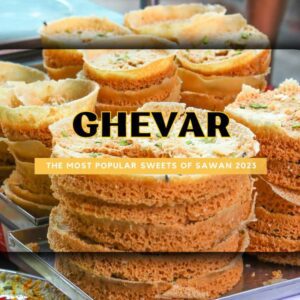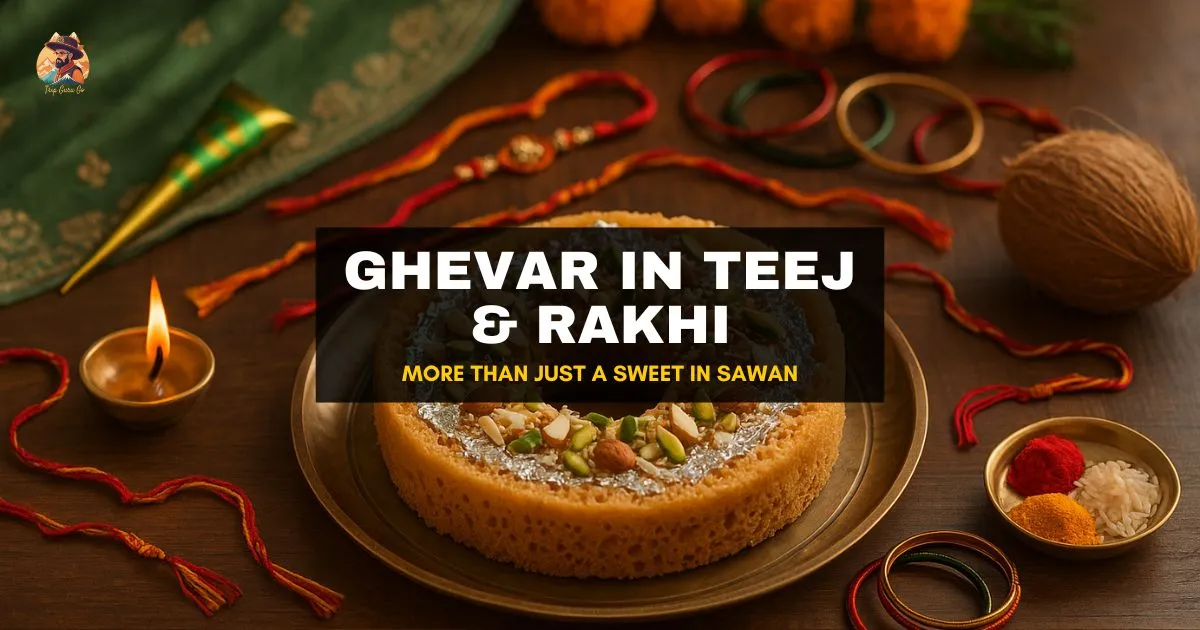
Every year when Sawan begins, I feel something shift inside me. It is not just the rain or the smell of wet soil. The season starts for me the moment I see Ghevar in Teej & Rakhi rituals, quietly making its way back into our home. That yellow box with silver foil, the smell of ghee and saffron, and the excitement of coming festivals — it all hits at once.
I have grown up watching Ghevar arrive like a guest of honour in our house. It comes with love from my nani’s home, packed with bangles and new clothes for my mother. Sometimes it reaches my sister as part of her Teej gift. Sometimes it sits silently on the dining table, waiting for Rakhi morning. I have eaten Ghevar in the middle of laughter, during silence, after rituals, and even while crying quietly in a corner once. It is more than a sweet. It is part of who we are during these monsoon months. This article explores why Ghevar in Teej & Rakhi holds a sacred place in North Indian homes and hearts.
What Makes Ghevar a Ritual Sweet in North India

I still remember the shine of that Ghevar in my mother’s thaali. A soft disc, golden at the edges, soaked in ghee and wrapped in oily paper. The rain had just stopped outside, and the smell of wet soil was still floating in through the window. She placed the sweets near the puja shelf and closed her eyes for a moment. That small act, quiet and simple, showed me how one sweet could carry the weight of a full tradition.
Back then, I only saw it as a sweet. But year after year, I began to understand — Ghevar in Teej & Rakhi is not just tradition, it is an emotion passed down through generations.
In North India, Ghevar holds a sacred space in both festivals. It is not a sweet you pick up casually. It arrives with rain, rituals, and remembrance.
Let me tell you why this one sweet feels more like a ritual than just dessert:
- 🎁 Sent as part of “Sindhara” during Teej — a mother’s love wrapped in bangles, clothes, and sweets
- 🙏 Placed in puja thali with mehendi, coconut, and glass bangles — especially during Hariyali Teej
- 👩👧 Given to daughters after their Teej fast — symbolising sweetness in marriage and blessings
- 👫 Served during Rakhi as a return gift — often paired with tilak, dry fruits, and warm laughter
- 🕉️ Offered as bhog in Sawan Somwar and local rituals across Rajasthan, Haryana, and UP
Even today, when I walk past a Ghevar shop in Faridabad or Chandni Chowk and see silver foil glistening under soft yellow light, I stop without realising. I look at that sweet and feel it all over again — the joy of Teej, the silence of Rakhi mornings, and the simple truth that some rituals are best tasted, not just told.
Ghevar and Hariyali Teej – The Ritual Every Daughter Waits For
There is something about Teej that always feels soft, silent, and full of love. It is not a loud festival, but the rituals carry so much emotion, especially for women. And right at the center of this emotion sits Ghevar. Not just as a sweet, but as a quiet messenger of blessings, memories, and a mother’s touch.
🟢 Why Teej Ghevar Is More Than Just a Sweet

On Teej mornings, my mother would wake up before sunrise, quietly dress in green, and sit near the window with a thaali in her lap. Among the bangles, coconut, and mehendi cones, one thing always stood out — a round, saffron-kissed Ghevar.
She never touched it before her vrat ended. I would ask her, “Why Ghevar, not something else?” She would smile and say:
“Teej ki meethaai sirf khane ke liye nahi hoti. Yeh rishton ke liye hoti hai.”
Over the years, I understood what she meant.
📿 Teej Festival Rituals Where Ghevar Plays a Role:
- Puja Offering: Placed in the Teej puja thali beside the coconut and bangles
- Vrat Sweet: Eaten after breaking the nirjala vrat (waterless fast)
- Symbolism: Round shape = unity, saffron = warmth, ghee = abundance
- Blessing in Sweet Form: Shared with neighbors and family like prasad
- Spiritual Connection: Offered to Goddess Parvati for blessings in marriage
In Rajasthan and Haryana, Ghevar is prepared only in Sawan. It is not available year-round. That makes it feel sacred, rare, and full of emotional weight.
🟢 Gift Boxes from Maayka – A Ritual of Love

Teej was never just a one-house celebration. It travelled from maayka to sasural, packed inside red and gold boxes.
Every year, my sister would receive a Sindhara — a parcel from our nani’s house. It always included:
- 💚 A green sari
- 💠 Glass bangles
- 🌿 Mehendi cone
- 🍬 And always, one Ghevar wrapped in foil
She would unwrap it like it carried her whole childhood inside.
Even today, many families continue this beautiful ritual. Some do it by courier, some send it with relatives. Many add a designer twist, with dry fruits or malai toppings. But the meaning remains the same:
Ghevar is not just sweet. It is maayka ka pyaar, wrapped in sugar. During Teej and Rakhi, many people also include Malpua, Peda, and Barfi in their sweet boxes. If you want to explore more such monsoon delights, check out the top Sawan sweets enjoyed across North India.
Ghevar for Raksha Bandhan – A Taste of Sibling Bond

I still remember that one Rakhi when my sister arrived with a bright red box and an even brighter smile. It was raining outside, the kind that smells like earth and silence. She opened the box carefully — inside was a Ghevar wrapped in foil, its edges golden, with two tiny rakhis tucked beside it. For many siblings, Ghevar in Teej & Rakhi feels like a bridge between festivals and memories.
She said, “Bhai, yeh Jaipur se laayi hoon. Sirf tere liye.”
That Ghevar was not just a sweet that day — it was the whole festival.
🟢 Why Ghevar Is Gifting Gold for Rakhi

When I was younger, Raksha Bandhan meant early mornings, steel thaali sets, and my sister carefully arranging everything — rakhi, kumkum, rice, dry fruits, and one thing she never missed: Ghevar. She said it was like gifting a piece of Sawan along with her prayers.
Over time, I noticed that Ghevar had quietly become the preferred rakhi sweet in many homes around us. It had something special that other sweets like laddoo or kaju katli could not offer — the taste of season + emotion + tradition, all in one.
🎁 Why Ghevar Feels Like Gifting Gold:
- Symbol of Seasonal Blessing – It is made only during Sawan, so it feels rare and special
- Looks Like a Celebration – Golden color, silver foil, dry fruit topping = perfect gifting vibe
- Carries Cultural Weight – Deeply rooted in both Teej and Raksha Bandhan rituals
- Tastes Rich Yet Familiar – Malai or rabri toppings make it festive, yet nostalgic
- Packaging Love – Now available in beautiful designer boxes, ideal for gifting brothers or sisters
If you are planning to buy Ghevar for Rakhi, make sure it is made fresh. Most traditional shops in Delhi and Jaipur start preparing Rakhi batches two days before the festival. Ask for desi ghee versions — they last longer and taste richer.
🟢 Raksha Bandhan Traditions in Rajasthan & Delhi

In Rajasthan, the Raksha Bandhan thali is not complete without Ghevar. Sisters wake up early, prepare the plate with haldi-kumkum, rice, and sweets, and Ghevar is always the centerpiece. Many families believe it brings sweetness to the bond, just like the rakhi itself brings strength.
In Delhi, the trend has evolved. Now you will find:
- 🧺 Ghevar Gift Hampers – with dry fruits, rakhis, scented candles, and roli chawal sets.
- 🛍️ Same-day delivery for Ghevar – from iconic shops like Nathu Sweets, Bikanervala, and Kanwarji.
- 🏠 Home-made Ghevar – increasingly seen in some NCR housing societies, especially in areas like Faridabad and Noida, where festive cooking traditions are cherished in local families.
Many brothers now gift Ghevar back to their sisters as a sweet return gesture. And that, to me, feels like a full circle of love.
One thread, one sweet, and one moment of silence — that is what Raksha Bandhan really is for me.
Ghevar and the Sawan Season – A Monsoon Tradition
Sawan is not just a change in weather. It is a mood. The wind feels softer, the rain feels more personal, and every sweet shop in North India begins to glow with trays of fresh Ghevar. It only comes out when the sky turns grey — never before, never after.
There is something sacred about eating Ghevar during Sawan. Maybe it is the way it absorbs the monsoon air or how its sweetness feels warmer on a wet afternoon. But for many of us, the first glimpse of Ghevar means the season has truly begun.
🟢 Sawan Rituals Where Ghevar Is Served
One morning in Jaipur, during Sawan Somwar, I watched a woman fold her hands after placing a piece of Ghevar near a tulsi leaf in the temple. No loud chants, no crowd — just a silent offering. That moment stayed with me.
In many regions of North India, Ghevar quietly becomes part of Sawan traditions:
- 🕉️ Temple Bhog – In many homes, Ghevar is offered as prasad with milk, tulsi, or coconut during Sawan Somwar. While not officially part of temple rituals, it holds symbolic value in local customs.
- 🪔 Teej Puja Thaalis – Placed alongside glass bangles, haldi, and mehandi in rituals led by women
- 🍃 Vrat-Ending Sweet – Eaten as the first bite after completing Teej or Sawan fasts
- 👪 Shared with Neighbours – A slice of Ghevar is often exchanged during Sawan Mondays, like prasad
Even though this may not be a written rule in books, it is these quiet customs that keep traditions alive, passed on not by instructions, but by memories.
🟢 Why Ghevar Is Perfect for the Rainy Month
There is a reason why Ghevar is not made year-round. It belongs to this season. Ghevar’s honeycomb texture forms best when the air is humid. The ghee smells stronger. The taste holds better. Even the silver foil on top looks brighter against a cloudy sky.
🌿 What Makes Ghevar a Monsoon Sweet:
- Prepared Best in Humid Weather – The signature texture depends on Sawan’s moisture
- Feels Cooling and Comforting – Served cold, it balances the heat after a warm afternoon
- Paired with Rabri or Malai – Makes it richer and more festive
- Seasonal Symbolism – It arrives only when rain and rituals return together
- Emotionally Timed – Ghevar is not just eaten, it is awaited
And maybe that is the most beautiful thing. You do not buy Ghevar like any other sweet. You wait for it — like the first rain, like the first rakhi, like the first smile after a long silence.
Rituals, Region & Religion – Ghevar Across North India
Every time I travelled through North India during Sawan, I noticed something beautiful — Ghevar never stayed the same. In Rajasthan, Ghevar becomes part of the Sindhara tradition, wrapped with bangles and love. Uttar Pradesh temples often place it quietly in their puja thaalis, like a sweet prayer. In Haryana, mothers pack it tenderly as part of blessings sent to daughters during Sawan. And in Delhi, it appeared in shiny boxes and sweet shop windows.
One sweet, many meanings. Ghevar may shift in toppings or packaging, but the emotion stays the same — it always tastes like monsoon mixed with memory.
🗺️ Traditions in Rajasthan, UP, Haryana & Delhi NCR
Ghevar is not just a festive treat. In every region, it holds a place of ritual, season, and personal memory.
🌼 Rajasthan – Royal Sweet of Teej
- Malai or rabri-topped Ghevar is a signature during Sawan.
- It is sent with Sindhara — a gift box from a girl’s maternal home during Teej.
- Jaipur families trust iconic shops like LMB and Bombay Misthan Bhandar.
🌿 Haryana – Bhaat & Family Rituals
- Ghevar is included in bhaat (gifts from the maternal side).
- Families enjoy it together after the Sawan Somwar pujas.
- Many homes in Faridabad also prepare it fresh during the rains.
🎡 Uttar Pradesh – Sweet for the Gods
- In Mathura, Agra, and Ayodhya, Ghevar is offered in temples.
- During Jhoola Pujas and Krishna Janmashtami, it is part of the bhog.
- Sometimes included in Chhappan Bhog for Lord Krishna.
🏙️ Delhi NCR – From Tradition to Trend
- Ghevar has become a gifting favourite for Teej and Raksha Bandhan.
- Designer boxes sell out fast at Nathu’s, Kanwarji, and Bikanervala.
- Homemade Ghevar is popular in housing societies across the NCR.
📌 Wherever you go, Ghevar is never just a sweet. It is a memory, a ritual, and a sign that Sawan has truly arrived.
🛕 Temple Offerings, Puja Plates & Sweet Bhog
In both homes and temples, Ghevar is not eaten first — it is offered first.
- Teej Thaali: Ghevar is placed with bangles, coconut, and mehendi before breaking the vrat.
- Krishna Temples in Mathura & Vrindavan: Ghevar is offered during Jhulan Yatra and Janmashtami.
- Home Temples: Many families place a small piece of Ghevar on the home altar before sharing it.
- Chhappan Bhog: In some traditions, Ghevar is included as one of the 56 items offered to Lord Krishna.
🌸 Even if you do not follow every ritual, keeping Ghevar near your temple, closing your eyes, and sharing it with love — that alone feels like a prayer.
Final Thought – Ghevar in Teej & Rakhi Is a Feeling, Not Just a Sweet
Every time I hold a Ghevar box during Sawan, I do not just taste sugar and ghee. A taste of silence precedes the Teej sunrise. The quiet hug of a sister on Rakhi is felt deeply. Blessings, wrapped in foil, carry their own unique flavor. Ghevar in Teej & Rakhi is not about one bite. It is about one feeling — that home is still close, that festivals still carry heartbeats.
So next time you unwrap this monsoon sweet, pause for a second. Feel what it holds. Because sometimes, the simplest rituals carry the deepest roots. Ghevar in Teej & Rakhi reminds us that sweetness is not just in taste, but in every memory and ritual it carries.
👉 Dive into our full guide on Ghevar’s history, types, Sawan rituals, and health tips:
🔗 Ghevar – Sawan Sweet of North India
FAQs – Ghevar, Teej, Rakhi & Sawan Traditions
Families gift Ghevar as part of the Sindhara from a woman’s maayka (mother’s home), along with mehendi, bangles, and green saris. They place Ghevar in the Teej puja thali to bless her marriage with harmony and sweetness.
Yes, absolutely. Families across Rajasthan, Delhi, and NCR often gift Ghevar on Raksha Bandhan. They choose it for its golden color, fresh seasonal taste, and festive packaging. Many shops now offer designer Ghevar boxes online, often paired with dry fruits and rakhis.
People make Ghevar during Sawan (monsoon season) because the humid weather helps form its honeycomb texture perfectly. Families prepare and enjoy Ghevar during this time to welcome the rains with sweetness and tradition. Many homes also share Ghevar with neighbors, turning it into a warm seasonal ritual.
Ghevar is rich and indulgent, made with ghee, flour, and sugar syrup. Malai or rabri toppings add more richness. It is best enjoyed in moderation, like other festive sweets. You can choose mini portions or ask for less syrup if you want a lighter version.

Hi, I am Manoj Kumar, the voice behind Trip Guru Go. I am a travel researcher, SEO content expert, and founder of this blog. With over 12 years of experience in digital travel research, I simplify complex destinations into real, helpful, and trustworthy guides.
Every article I write is backed by local sources, real traveler experiences, and deep fact-checking. Even if I have not visited every place personally, I never share anything without strong on-ground insight.
I do not sell travel packages or promote anything paid. My only goal is to help you travel smarter — with zero fluff, 100% honesty, and a deep focus on your safety and experience.