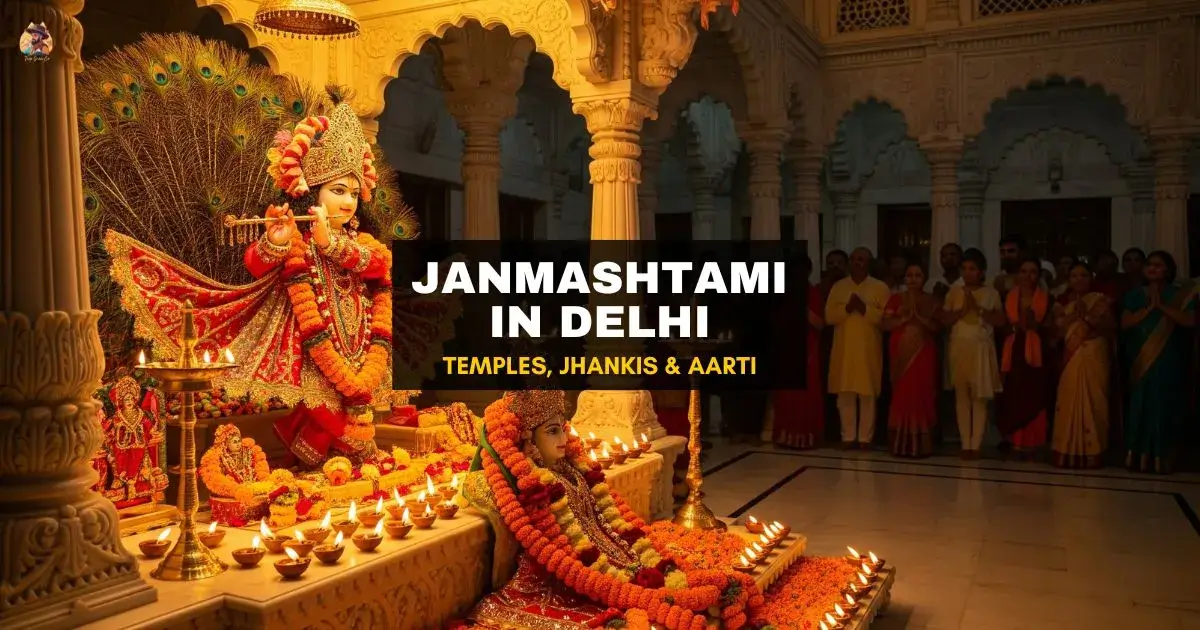
I still remember the night I waited outside the ISKCON Temple in the East of Kailash during Janmashtami in Delhi. The marble felt cool under my feet. Around me, strangers stood in silence — some with flowers in hand, some with eyes closed. It was almost midnight. The sound of a conch echoed. And just for a second, I felt something shift — not outside, but inside.
Janmashtami in Delhi in 2025 will bring that same moment again for thousands. Whether you are visiting for the first time or returning with deeper devotion, this guide will help you navigate the celebration with ease, warmth, and purpose. And if you want to explore how this festival is celebrated across Mathura, Vrindavan, and more, read our full guide on Janmashtami in India (2025).
Here is what I will walk you through, based on my own journey:
- 🗓️ Exact Janmashtami 2025 date and midnight aarti timings
- 🛕 List of must-visit Krishna temples across Delhi
- 🎭 Where to see beautiful Krishna Jhankis with family or friends
- 🚇 Nearest metro routes to temples, even during late hours
- 👪 Tips for first-time visitors, solo travelers, and foreign tourists
- 🍛 Where to find bhog, prasad, and falahari food during the festival
This is not just another festival guide. It is a conversation from one traveler’s heart to another.
Janmashtami 2025 Date & Aarti Timing in Delhi
When the temple bells rang at midnight, it felt like time had paused. I was outside ISKCON East of Kailash, barefoot on cool marble. Around me, hundreds stood still. As the conch echoed, something shifted — not just around us, but within us.
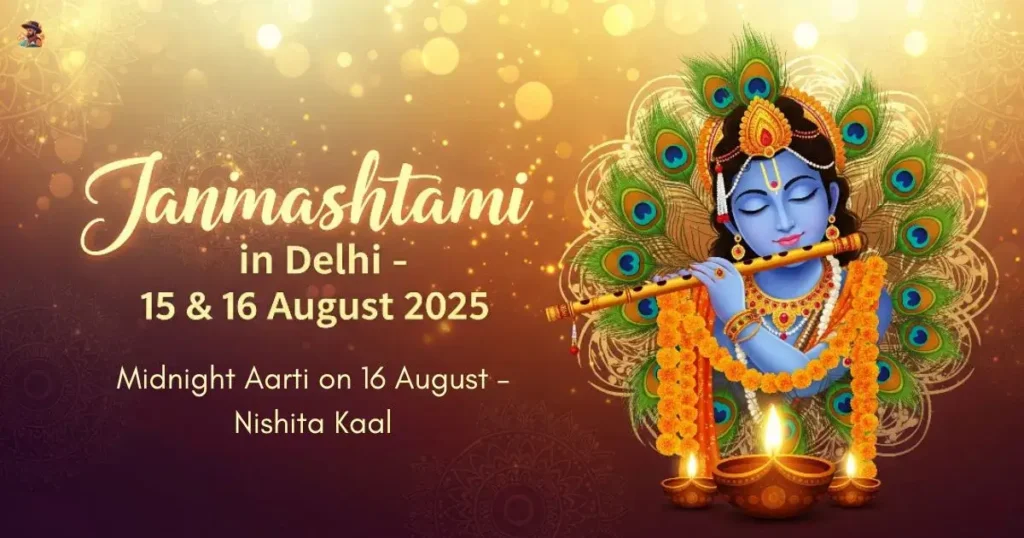
🗓️ Janmashtami 2025 Dates in Delhi
In 2025, Janmashtami in Delhi will be celebrated across two special nights:
- 15 August 2025 (Friday): Early events, cultural programs, and Jhankis
- 16 August 2025 (Saturday): Fasting, bhajans, and the main midnight aarti
Confusion about dates is common. But the actual Janmotsav, or Krishna’s birth moment, is observed late on the night of 16 August.
🕛 Midnight Aarti Timings (Across Delhi)
Most temples follow the nishita kaal, the sacred window of Krishna’s birth. While the celebrations begin on the 16th, the aarti happens just after midnight, in the early hours of 17 August.
Here are the expected aarti timings at major temples:
- ISKCON, East of Kailash – 12:10 AM to 12:45 AM (Aug 17)
- ISKCON, Dwarka – 12:15 AM to 12:50 AM (Aug 17)
- Birla Mandir, Connaught Place – 12:00 AM to 12:30 AM (Aug 17)
- Gauri Shankar Temple, Old Delhi – 12:10 AM to 12:40 AM (Aug 17)
🕔 Note: Most temples close entry between 9:00 and 9:30 PM, depending on crowd flow. Always check the temple’s official website or social media for updates. And yes, like every temple in India, do remember to remove your footwear outside. You will likely leave your shoes near the gate, so avoid wearing anything too expensive.
🌙 Fasting, Bhog & Rituals
In Delhi, most devotees observe a full-day fast on 16 August, breaking it only after midnight. I followed the fast last year. By sunset, I was exhausted. But as the aarti neared, something in me felt light — even joyful.
- Fasting Duration: From sunrise to midnight
- Bhog Offering: After 12:15 AM
- Prasad Distribution: Begins around 12:45 AM
Some traditions may break the fast the next morning based on tithi and nakshatra. But most Delhi temples follow the midnight nishita kaal rule. If you want to be precise, ask your temple priest or check ISKCON’s spiritual calendar.
Temples like ISKCON Dwarka and Rohini also serve falahari thalis. I saw volunteers giving bananas and sweets to children waiting in line — a small act, but full of warmth.
🌟 Additional Tips & Highlights
- 🎉 Dahi Handi celebrations usually take place on 16 August, especially in Janakpuri, Rohini, and Laxmi Nagar. These events are energetic, with local youths forming human pyramids to break the pot.
- 🎫 Some larger temples may have VIP darshan passes or special queue systems. While I followed the regular route, it is worth checking official temple announcements if you need extra assistance.
👣 My Local Tip
Arrive 2 to 3 hours before midnight. I reached ISKCON at 9:45 PM last year and still had a long wait. But wait, it became part of the prayer. The bhajans in the background, the smell of marigold, and the buzz in the air — it was not just a line. It was a feeling.
Best Temples to Visit for Janmashtami in Delhi
Every temple in Delhi has its own mood during Janmashtami. Some are loud and festive. Some feel still and sacred. I have visited quite a few over the years, and each one gave me something different. If you are planning your temple visits this year, these are the ones I personally recommend, especially for first-timers, families, or anyone who wants to truly feel Krishna’s presence.
🛕 ISKCON Temple, East of Kailash (Nehru Place Metro)
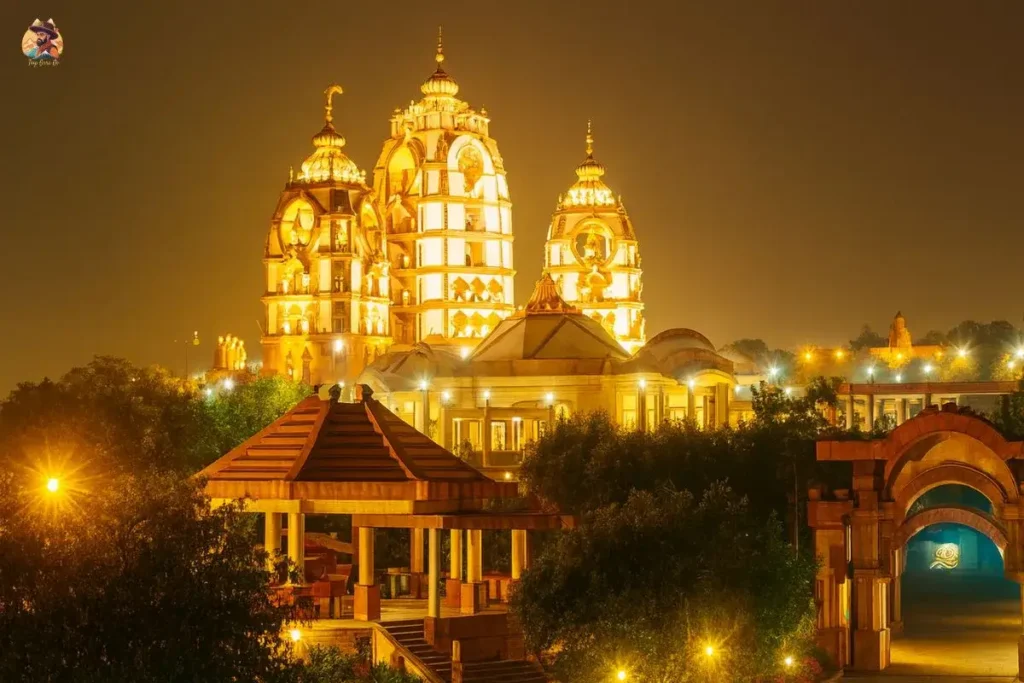
This is where Janmashtami feels alive. I reached here just before 10 PM last year, and the moment I entered, the energy hit me. The bhajans were loud, the lights were golden, and the crowd — though massive — moved like a river of faith. It did not feel chaotic. It felt united.
- Why Visit: Midnight aarti here is unforgettable. Devotees sing, dance, and cry together. The main altar opens just after 12:10 AM.
- Prasad & Bhog: After the aarti, volunteers hand out tulsi prasad and dry-fruit bhog. Some devotees bring homemade sweets to offer too.
- How to Reach: Get down at Nehru Place Metro Station (Violet Line). Take an e-rickshaw from Gate 3 — it is a 5-minute ride.
- Entry Tip: Reach by 9:00 PM to avoid gate closures.
This is the heart of ISKCON Janmashtami in Delhi — if you experience just one temple, make it this one.
🛕 Birla Mandir (Laxminarayan Temple), Connaught Place
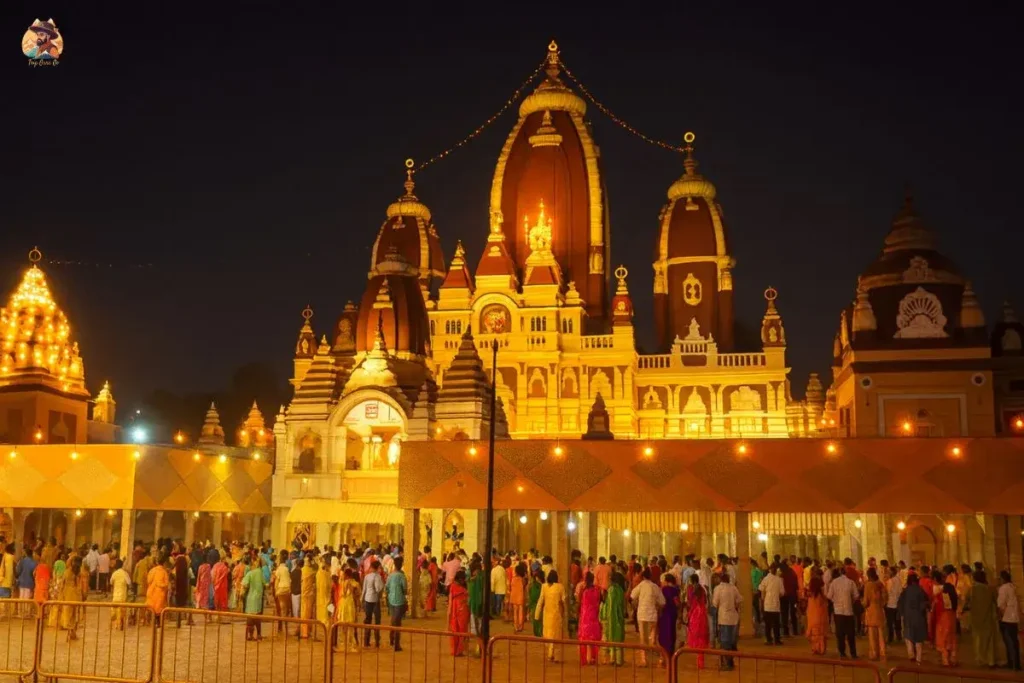
If you are going with your parents or small children, this is the best option. It is cleaner, calmer, and less overwhelming than ISKCON.
- Why Visit: The temple hosts beautiful evening Jhankis, decorated with lights and flower carpets. There is space to sit, which helps older devotees.
- Prasad Tip: You can get dry prasad from the counters outside. I usually buy a packet and take it home for my family.
- How to Reach: Take the Blue Line metro to R.K. Ashram Marg or Shivaji Stadium (Airport Line). Both are 10–12 minutes away on foot or auto.
This is where the Janmashtami celebration in Delhi feels more peaceful and family-oriented.
🛕 Gauri Shankar Temple, Chandni Chowk
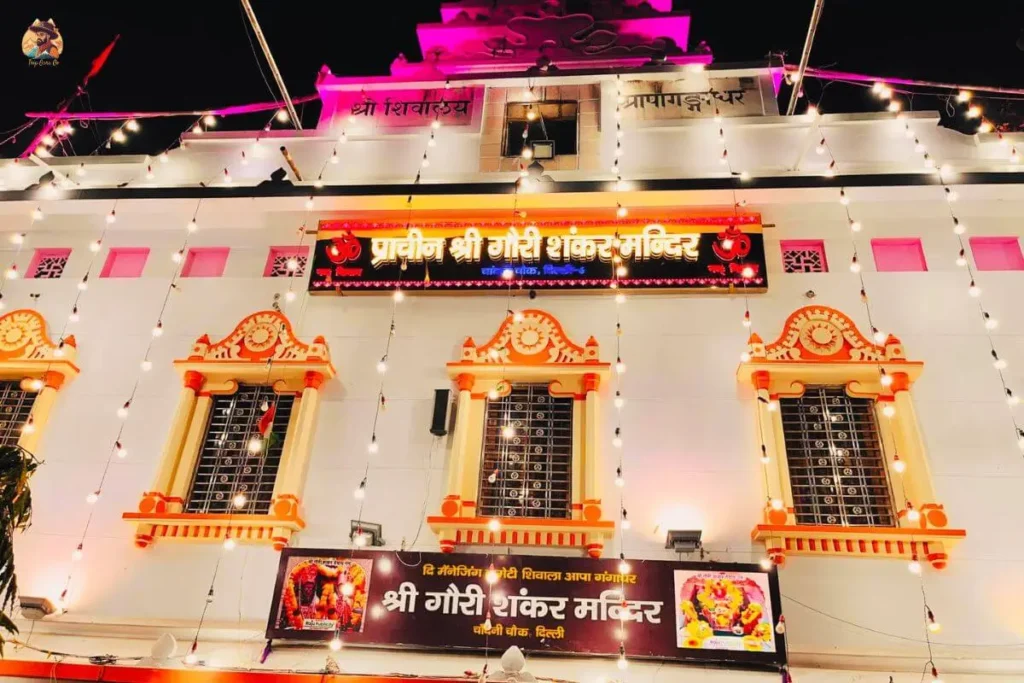
The first time I came here, I almost turned back. The lanes were packed, rickshaws were stuck, and the honking never stopped. But once I stepped inside the temple, everything softened. It was quiet, glowing with diyas, and full of bhajans that felt centuries old.
- Why Visit: Perfect for those who want to see how Old Delhi celebrates Janmashtami — raw, real, and intimate.
- Best Time: Come around 9 PM. The crowd is thinner, and the temple glows in soft light.
- How to Reach: Take the Yellow Line metro to Chandni Chowk. From there, walk through the spice market — it is an experience in itself.
It is not polished or fancy. But if you want to feel Krishna in the middle of chaos, come here.
🛕 Akshardham Temple (Spiritual Atmosphere Only)
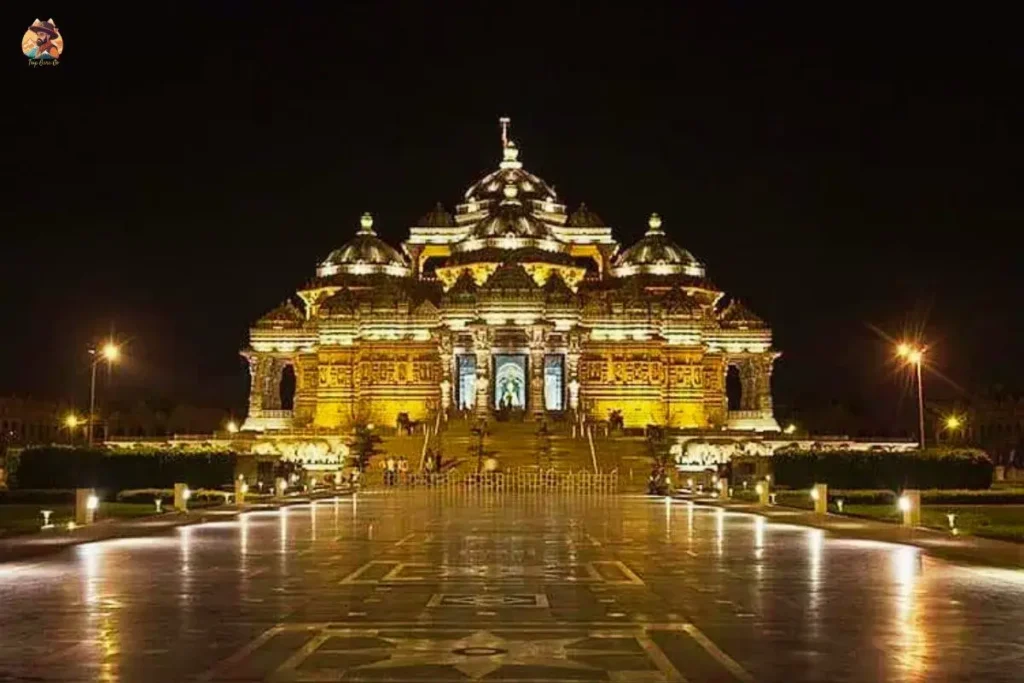
Let me clarify: Akshardham Temple does not host Janmashtami events like other temples do. There is no midnight aarti or Jhankis. But the space itself is so spiritually charged that you might still want to visit during the day.
- Why Visit: The silence here feels deep. The architecture itself tells Krishna’s story.
- Photography Tip: Phones and cameras are not allowed inside. Store them safely in the cloakroom.
- How to Reach: Take the Blue Line metro to Akshardham Station. The temple is right outside the metro gate.
Visit not for the crowd or events, but to reflect, breathe, and feel connected. Planning to explore more spiritual places, food spots, and hidden gems in the city? Browse all our local travel stories in the Delhi travel archive.
Where to See Krishna Jhankis in Delhi (2025)
I still remember standing in Lajpat Nagar last year, watching a little boy dressed as Krishna. He sat in a cradle made of mango leaves, eyes closed, smiling gently. A flute played in the background. Lights flickered. For a moment, it felt like I was not in Delhi — I was in Vrindavan.
Krishna Jhankis in Delhi are not just decorations. They are living stories of devotion — hand-built, heartfelt, and deeply moving. You will find them glowing in temples, colony parks, school lawns, and even community halls. These are some of my favorite places to experience them.
🛕 ISKCON East of Kailash & ISKCON Dwarka
These are the epicentres of Janmashtami Jhankis in Delhi — elaborate, soulful, and full of crowd energy.
- Witness full Krishna Leela sequences with moving carts, fog machines, and live bhajan groups
- Separate darshan lines for women and family areas make it manageable even in big crowds
- Jhankis are viewable all day on 16 August, but the peak time for atmosphere and crowd energy is 8 PM to 11:30 PM
- Metro Access: Nehru Place (Violet Line) or Dwarka Sector 10 (Blue Line)
🕔 Note: Delhi Metro usually runs till 11:30 PM, so plan your return. After midnight, cabs or autos may be needed.
I usually reach early to absorb the peace before the night rush.
🏡 Birla Mandir Lawns, Connaught Place
If you want something quieter and more child-friendly, this is the place.
- Featuring Jhankis crafted by school children and temple volunteers
- I once saw a peacock made of salt and flowers, placed gently at Krishna’s feet — so simple, yet so touching
- Best time: 6 PM to 10 PM on 15 and 16 August
- Metro Access: R.K. Ashram Marg (Blue Line) or Shivaji Stadium (Airport Line)
This spot feels peaceful — perfect for elders and first-time visitors.
🌆 Local Colonies: Rajouri Garden, Lajpat Nagar, Karol Bagh
Some of the best Janmashtami Jhankis in Delhi are tucked away in everyday neighborhoods.
- Rajouri Garden: Dramatic Leelas, sometimes performed live on open stages
- Metro: Rajouri Garden (Blue & Pink Lines)
- Lajpat Nagar: Spiritual art mixed with festive food — last year, I watched a Radha-Krishna dance while eating kachori
- Metro: Lajpat Nagar (Pink & Violet Lines)
- Karol Bagh: Community-built Radha-Krishna scenes in gated parks and colony halls
- Metro: Karol Bagh (Blue Line)
🚕 Tip: Once you exit the metro, ask any shopkeeper or auto driver. Most of them know which lane or park is hosting the evening’s main Jhanki.
🪔 In places like Janakpuri and Pitampura, you may also see Dahi Handi celebrations earlier in the evening — usually in the same colony park as the Jhanki.
🎒 School & Community Jhankis – 15 August
Before the temple crowds swell, many schools and colonies host Jhankis on 15 August, right after Independence Day events.
- These are quieter, more personal, and often more emotional
- Held in local parks, mandir compounds, and gurudwara halls
- One moment stayed with me: a little girl dressed as Radha slipped mid-dance. The crowd clapped as she stood up, smiling — no judgment, just love.
How to Reach Janmashtami Temples in Delhi by Metro
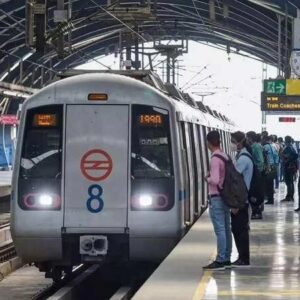
If you are planning to explore Janmashtami temples in Delhi, the metro is your best friend. It is fast, cheap, safe, and runs close to almost every major temple — even in crowded areas like Chandni Chowk or Karol Bagh.
Last year, I hopped across three temples in one evening using just the metro and short e-rickshaw rides. It saved me from traffic, parking stress, and extra walking in crowded lanes.
Here is how you can plan smartly:
📍 Temple-Wise Metro Guide
ISKCON East of Kailash
- Nearest Metro: Nehru Place (Violet Line)
- Exit Tip: Use Gate 3 and take an e-rickshaw (₹20–₹30, 5 mins)
- Walkable? Yes, but about 15 minutes — avoid if you are fasting or with elders
Birla Mandir, Connaught Place
- Nearest Metro: R.K. Ashram Marg (Blue Line) or Shivaji Stadium (Airport Line)
- Exit Tip: Use Gate 1 at R.K. Ashram Marg for the quickest auto access; walking is safe and takes under 10 minutes
Gauri Shankar Temple, Chandni Chowk
- Nearest Metro: Chandni Chowk (Yellow Line)
- Exit Tip: Take the Kucha Mahajani side exit and walk or hire a cycle-rickshaw through the market
- Local Tip: Wear comfortable shoes — lanes are uneven and very crowded during festivals
Akshardham Temple
- Nearest Metro: Akshardham Station (Blue Line)
- The temple is right across the road from the station, just a 2-minute walk
🕯️ Note: Akshardham does not host Janmashtami events, but the spiritual atmosphere is worth experiencing during the day.
🕔 Metro Timing vs Midnight Aarti
Here is something most people miss — Delhi Metro usually closes by 11:30 PM, while midnight aarti happens between 12:04 AM to 12:47 AM.
So what do I do?
- I take the metro to reach by 8 or 9 PM
- After midnight, I book a cab or an auto from outside the temple
- Keep your phone charged and Uber/Ola ready — the network gets patchy in big crowds
If you are a solo traveler, do not wait too long after midnight. Head toward the main road early and share an auto if possible.
💰 Budget Tips & Local Travel Help
- E-rickshaws charge ₹20–₹40 for last-mile drops
- Avoid driving: Parking is chaotic during Janmashtami, even for locals
- Carry change: ₹10 and ₹20 notes help for autos and small shops
Last year at ISKCON, I shared an auto with a traveler at 12:45 AM. She got down near Kailash Colony, and I rode to Lajpat Nagar. It felt safe, and we both saved money.
👪 Family & First-Timer Advice
- Use metro stations with escalators or lifts if traveling with older parents
- Women traveling alone can use the metro comfortably till 10 PM
- After exit, stick with temple crowds — avoid taking shortcuts through dim lanes
Prasad, Bhog & Janmashtami Food in Delhi Temples
After fasting all day, the first bite of Janmashtami bhog tastes like peace. I still remember standing in line at ISKCON East of Kailash last year. The halwa was warm, sweet, and served with a quiet “Hare Krishna.” At that moment, it felt like a blessing, not a dish.
🍚 What Bhog Is Offered?
Most temples begin bhog offerings just after midnight aarti. Common items include:
- Halwa, Makhan Mishri, Panchamrit
- Dry fruits, tulsi-laced sweets, and Charanamrit (a sacred mix of milk, honey, tulsi, and holy water — offered as the nectar from the Lord’s feet)
- Fruit platters and milk-based satvik dishes
At ISKCON, the prasad is simple but pure. Served with heart, not just hands.
🎁 Free vs Paid Prasad (ISKCON Delhi)
- Free prasad (halwa or fruit) is served after the midnight aarti
- Paid prasad boxes (₹30–₹150) are available during the day — these include sweets, dry fruits, sometimes tulsi mala
- You can also sponsor bhog as a family offering
🥗 Falahari Stalls & Temple Canteens
From afternoon onwards, many temples set up falahari stalls with:
- Sabudana khichdi, aloo tikki, milk sweets, fruit chaat
- ISKCON and Birla Mandir have clean satvik counters
- I had Singhade ke atte ki poori near Dwarka ISKCON — hot, crisp, and fast-friendly
Avoid bringing outside food into temple areas — keep it satvik.
🌮 Bonus: Janmashtami Street Food (Post-Fast)
After darshan, if you are ready to explore:
- Walk to Bengali Market from Birla Mandir for kulfi or khurchan
- In Karol Bagh, many sweet shops stay open till 1 AM — try fresh peda or ghewar
Just eat after breaking your fast, and keep water with you. Crowds will be heavy, and seating rare.
Janmashtami in Delhi for Families, Tourists & First-Timers
Janmashtami in Delhi is not just about faith. It is about people — kids running around in Krishna crowns, grandparents sitting on temple stairs, and couples whispering “Radhe Radhe” while holding hands. I remember once guiding my cousin’s toddlers through the crowd near Birla Mandir. One of them folded their hands, looked up at the idol, and smiled. That moment still stays with me.
If you are visiting for the first time — or bringing kids or elders — here is what I have learned from experience:
👣 Safe Areas for Families
- Temples like ISKCON East of Kailash and Birla Mandir are best for families.
- Security checks are tighter. Walking paths are cleaner. Volunteers help with directions.
- Avoid deep Old Delhi lanes like around Gauri Shankar Temple if you are with toddlers or older — it gets very congested.
👕 Dress Modestly
- Light cotton kurta, salwar, or sari works best.
- Cover your shoulders and knees.
- Avoid sleeveless tops or shorts — even tourists are expected to follow temple etiquette.
👥 Crowd Navigation Tips
- Arrive by 7:00 PM if you want calm surroundings. After 9:00 PM, it gets intense.
- Always hold hands with children. Assign a meeting point in case someone gets separated.
- Some temples give out queue tokens — check at the entry gate.
📸 Photography Rules
- Most temples do not allow flash photography inside the sanctum areas.
- Ask before filming bhajans or jhankis — especially at community setups.
- In ISKCON, phones are fine outside but not inside the main shrine.
☕ Rest & Recharge Nearby
- ISKCON Temple has benches and a clean canteen.
- Birla Mandir has lawns where elders can sit.
- Around Rajiv Chowk, you will find cafes and air-conditioned food outlets to rest before heading back.
That is what I tell every first-timer I meet during Janmashtami: come early, stay aware, and just let the devotion around you carry the day. And if you ever feel lost in the crowd, look for a child with folded hands — that is where you will find the heart of Janmashtami.
Live Darshan, Janmashtami Events & Virtual Aarti Links
I still remember the first time I watched ISKCON’s midnight aarti live on YouTube. It was during the lockdown. I sat alone in my Delhi flat, lights dimmed, volume high. As the conch blew and the chants echoed, it did not feel like I was alone anymore. That is the beauty of live darshan — even a screen feels sacred.
📺 Where to Watch Janmashtami Live in 2025:
- ISKCON East of Kailash:
👉 @iskcondelhitv YouTube Channel
Check their “Live” tab on 16 August for the official aarti stream. - ISKCON Dwarka:
👉 @ISKCONDwarka YouTube Channel
They usually go live around 11:30 PM with bhajans and Krishna abhishek. - Ministry of Culture (India):
👉 YouTube Channel |
May host national Janmashtami celebrations or cultural performances.
These links usually go live just a few hours before the main event. So keep them bookmarked, and open the YouTube app on full screen with headphones on. When the kirtan begins and the camera zooms into the decorated idol of Krishna, distance melts away, and you feel present, even from miles away.
Final Thoughts – Experiencing Janmashtami in Delhi With Devotion
Janmashtami in Delhi is not just a festival — it is an emotion that fills even the busiest corners with faith. I still remember standing near ISKCON as chants echoed and flower petals floated in the air, feeling something shift quietly within me. In this city, devotion comes alive in different ways — a child folding hands, an aunty distributing prasad, or a stranger saying “Jai Shri Krishna” with a smile. If this is your first Janmashtami here, soak it in slowly. And when you are ready to go deeper, let your next steps take you to Vrindavan or Mathura, where the story of Krishna never really ends.
If moments like these stay with you — soft chants, glowing diyas, and stories of divinity — then you will love our collection of spiritual travel experiences across India.
FAQs About Janmashtami in Delhi – Aarti, Travel & Temple Tips
Janmashtami falls on the evening of 16 August 2025, with cultural events also happening on 15 August. The main aarti occurs after midnight, in the early hours of 17 August.
Yes, 16 August 2025 (Saturday) is observed as a public holiday across most of Delhi for Krishna Janmashtami celebrations.
The midnight aarti takes place between 12:04 AM and 12:47 AM, during nishita kaal (the sacred midnight period of Lord Krishna’s birth).
Absolutely. I have attended solo many times, and it felt safe even in crowded spaces. Metro usually runs till 11:30 PM (check DMRC announcements for any festive extensions). Stay near families or groups and keep emergency contacts handy.
Most temple darshans, including ISKCON and Birla Mandir, are completely free. Some cultural programs or VIP seating may need prior booking.
For a peaceful darshan, I usually reach by 9:30 PM. Arriving 2–3 hours before midnight ensures you get in before gates close or crowds swell.
No, Akshardham does not host Janmashtami celebrations. It stays open for darshan but does not organise aarti or Krishna Jhankis.
Photography is not allowed inside sanctums. You can take pictures of Jhankis and outdoor events, but always ask permission or follow posted signs.
Wear modest, traditional clothes. For men: kurta-pajama or shirt-trousers. For women: a suit, a saree, or a skirt with a dupatta. Avoid revealing or flashy outfits.
Yes. Temples like ISKCON serve both free and paid prasad boxes, along with falahari meals and satvik thalis in their canteens.
Definitely. Foreigners are welcome at most temples. Just dress respectfully and follow temple etiquette. Seeing a child fold hands at a Krishna idol is the kind of quiet moment I always remember.

Hi, I am Manoj Kumar, a travel researcher and SEO content expert writing for Trip Guru Go, focused on Delhi and nearby travel destinations.
Being from Delhi NCR, I understand the travel preferences, routes, budgets, and experiences that travelers from this region actually look for. Every article I write is backed by local insights, real traveler experiences and detailed research to provide accurate and useful travel information.