Raj Ghat Delhi and Gandhi Smriti and Darshan Samiti are two separate memorial sites in Delhi, and many first-time visitors confuse them during planning. Rajghat Park marks the cremation site of Mahatma Gandhi on the Yamuna River bank. Gandhi Smriti is the Birla House where he was assassinated. Entry is free at both places, Raj Ghat remains open daily, and Gandhi Smriti is closed on Mondays. The nearest metro stations are Delhi Gate (Violet Line, closest walking access) or Indraprastha (Blue Line) for Raj Ghat, and Lok Kalyan Marg for Gandhi Smriti.
I have visited both sites multiple times, and the confusion usually begins with route assumptions rather than history. These memorials are not inside one complex. Raj Ghat feels open, landscaped, and minimal. Gandhi Smriti feels enclosed and museum-like, with marked final footsteps that naturally slow visitors down.
Families, school groups, solo travelers, and history-focused visitors benefit most from visiting here. Loud sightseeing expectations often lead to mild disappointment. This guide will help you plan clearly, avoid small mistakes, and decide how much time to give each place.
Here is a quick overview before we go deeper.
| Place | Type | Entry Fee | Closed Day | Nearest Metro |
| Raj Ghat (Rajghat Park) | Cremation memorial | Free | Open all days | Delhi Gate (closest), Indraprastha |
| Gandhi Smriti | Assassination site museum | Free | Monday | Lok Kalyan Marg |
Now that the basic differences and practical details are clear, let me explain the historical meaning and layout of Raj Ghat so you understand what you are actually seeing when you stand there.
Raj Ghat Delhi – History, Meaning & Memorial Layout
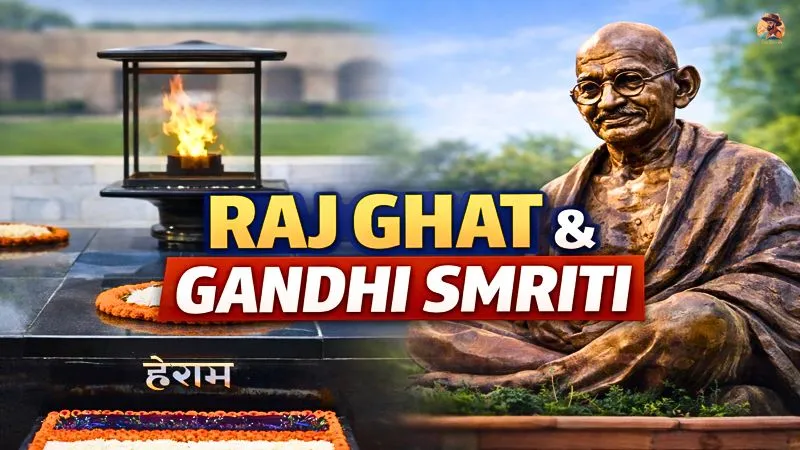
Raj Ghat Delhi marks the site where Mahatma Gandhi was cremated in 1948. It stands inside Rajghat Park along the Yamuna River bank. The memorial remains simple, without statues or domes.
What is Raj Ghat?
At the center stands a raised black marble platform with the words “Hey Ram” engraved on it, believed to be Gandhi’s last words. An eternal flame, known as the Akhand Jyoti, burns beside it as a symbol of continuity.
Visitor Tip: You must remove your shoes before stepping onto the marble platform area. A designated shoe-keeping stall is available near the entrance.
During one of my visits, I noticed how conversations softened naturally as people approached the platform. The open lawns and minimal design create a quiet atmosphere rather than a grand monument experience.
Raj Ghat Delhi History
Gandhi was cremated here on 31 January 1948, one day after his assassination. The landscaped gardens were developed later, and the site is officially preserved as a protected national memorial. Foreign dignitaries often lay wreaths here during state visits.
Raj Ghat Delhi Area & Nearby Memorials
Raj Ghat sits within a large landscaped memorial zone along the Yamuna river bank. The main samadhi platform stands at the center, surrounded by green lawns and paved walking paths.
What You Will Find Nearby:
- The Main Samadhi: The central black marble platform of Mahatma Gandhi.
- Veer Bhumi: The memorial of Rajiv Gandhi, spread across about 15 acres.
- Shanti Vana & Shakti Sthal: Memorials of Jawaharlal Nehru and Indira Gandhi.
- National Gandhi Museum: Located just across the road from the main entrance.
In simple terms, Raj Ghat is a minimal cremation memorial within a wider tribute landscape. Entry is free, footwear removal is required near the platform, and nearby memorials add historical depth to the visit.
Gandhi Smriti and Darshan Samiti – Birla House Experience
Gandhi Smriti and Darshan Samiti is located at Birla House in central Delhi. This is where Mahatma Gandhi spent his final days and was assassinated on 30 January 1948 during an evening prayer meeting. The setting feels enclosed and personal, very different from the open calm of Raj Ghat.
Gandhi Smriti Location
The former Birla House has been preserved as a public memorial. The exact assassination spot is marked by a stone pillar known as the Martyr’s Column. When I stood near that garden pathway, the space felt smaller than it appeared in photographs.
Gandhi Smriti Museum
Inside, a marked “Final Footsteps” path traces Gandhi’s last walk to the prayer ground. Visitors slow down naturally along this stretch. His simple room remains preserved with a low mattress and a spinning wheel beside it. The galleries display photographs and short exhibits about his life and final days.
Many expect a large modern museum. Instead, it feels like walking through a preserved historic home.
Gandhi Smriti Timings & Tickets
- Entry Fee: Free
- Closed Day: Monday
- Visit Duration: 45 to 60 minutes
Unlike Raj Ghat, which stays open daily, Gandhi Smriti remains closed on Mondays. Visiting both sites in one day is practical and usually takes around two hours at a relaxed pace.
Overall, Gandhi Smriti offers a close and personal memorial experience at the exact place of Gandhi’s assassination.
Timings, Entry Fee & Monday Closing
Before you plan the route, check the weekly closure carefully. Raj Ghat and Gandhi Smriti follow different schedules, and this detail often gets overlooked.
At a Glance
| Place | Opening Time | Closing Time | Entry Fee | Closed Day |
| Raj Ghat (Rajghat Park) | 6:30 AM | 6:30 PM | Free | Open all 7 days |
| Gandhi Smriti | 10:00 AM | 5:30 PM | Free | Monday |
Entry is free at both sites. No tickets are required.
Important Clarifications
- Raj Ghat remains open every day, including Mondays.
- Gandhi Smriti stays closed on Mondays, even when Raj Ghat is open.
- If Monday is your only available day, plan Raj Ghat and the nearby National Gandhi Museum instead.
Morning visits to Raj Ghat feel quieter, especially before 9 AM. Gandhi Smriti operates on fixed museum hours, so arriving before 4:30 PM allows enough time inside.
Health & Seasonal Note
From October to January, Delhi’s air quality can fluctuate. Raj Ghat is fully open and exposed, with limited shade. Checking live AQI through tools like SAFAR India before visiting helps you plan better, especially for older visitors or children.
How to Reach – Metro & Location Guide
Raj Ghat is located near Ring Road, close to the Red Fort and Daryaganj area along the Yamuna river bank. Gandhi Smriti stands in central Delhi near Teen Murti and India Gate. The two sites are about 6 to 7 km apart, so they are not within walking distance of each other.
Rajghat Park Nearest Metro
The closest station is Delhi Gate (Violet Line). From there, Rajghat Park is about 1 km away and takes 12 to 15 minutes on foot. The walking stretch has limited shade, so the late morning sun can feel harsh. A short auto ride is usually easier, especially in summer.
Indraprastha (Blue Line) is another option at roughly 1.5 km distance.
Gandhi Smriti Nearest Metro Station
The nearest station is Lok Kalyan Marg (Yellow Line). The walk is around 800 to 900 meters and usually straightforward. Autos are available outside the station, but most visitors prefer walking.
Distance from Key Areas
- Chandni Chowk (Old Delhi area) to Raj Ghat: 3–4 km
- Old Delhi Railway Station to Raj Ghat: Around 4 km
- Red Fort to Raj Ghat: About 2 km
- India Gate to Gandhi Smriti: Around 4–5 km
If you travel between Raj Ghat and Gandhi Smriti after 4 PM, expect 20 to 30 minutes by auto due to central Delhi congestion.
For a smooth plan, visit Raj Ghat first in the morning, then move toward Gandhi Smriti. This order reduces backtracking and feels more manageable in city traffic.
Best Time to Visit Raj Ghat & Gandhi Smriti
The time you choose changes how this visit feels. Raj Ghat is fully open under the sky, while Gandhi Smriti is structured like a museum with fixed hours. If you arrive late or during peak heat, the experience can feel rushed or tiring.
Time of Day Reality
- Before 9 AM: Raj Ghat feels calm and easier to walk
- 10 AM – 1 PM: Comfortable window to cover both sites
- After 4 PM: Traffic between them can take 20–30 minutes
- After 4:30 PM: Gandhi Smriti visit may feel rushed (closes 5:30 PM)
On one summer visit, by around 11 AM, the marble platform area at Raj Ghat felt noticeably warmer under direct sunlight. There is limited shade, and the open lawns reflect heat. Early morning felt far more comfortable.
Crowd & Photography Notes
- Weekdays are smoother than Sundays
- School groups often arrive mid-morning
- Morning light works best for Raj Ghat photos
- Follow the signage before photography inside Gandhi Smriti
If you plan to include Veer Bhumi (Rajiv Gandhi Samadhi area) and the National Gandhi Museum in your Gandhi Circuit, starting early keeps the route relaxed.
Health & AQI Tip
From October to January, air quality in Delhi can fluctuate. Raj Ghat has no indoor shelter and limited shade. Checking live AQI before visiting helps, especially for older visitors and children.
With the right timing, both memorials and nearby sites can be covered comfortably in half a day without feeling drained.
Exploring the Gandhi Circuit – Nearby Attractions
Raj Ghat sits within a larger memorial cluster along the Yamuna River belt. If you start early, you can explore several nearby memorials and Old Delhi landmarks in one smooth stretch without changing zones.
- National Gandhi Museum: Just across the road from Raj Ghat. Adds historical depth through letters, photographs, and personal artifacts.
- Gandhi Darshan (Paryavaran Complex): Inside the Raj Ghat complex area. A large exhibition and photo gallery space that many visitors overlook.
- Veer Bhumi (Rajiv Gandhi Samadhi Area): Spread across about 15 acres within the same landscaped memorial zone.
- Shakti Sthal: Memorial of Indira Gandhi, located close to Raj Ghat along the same river belt.
- Vijay Ghat: Memorial of Lal Bahadur Shastri, also part of this Yamuna memorial stretch.
- Red Fort: Around 2 km from Raj Ghat, and easy to combine in the same visit.
- Chandni Chowk: About 3–4 km away. Ideal for exploring Old Delhi markets after a morning memorial visit.
- Daryaganj: Roughly 1–2 km from Raj Ghat, known for food spots and the Sunday Book Market.
If planned properly, Raj Ghat, nearby memorials, and either Red Fort or Chandni Chowk can comfortably fit into a half-day plan without feeling rushed.
Conclusion – Raj Ghat & Gandhi Smriti
Raj Ghat and Gandhi Smriti are best suited for travelers who value history, silence, and meaning over spectacle. Families, students, and solo visitors will appreciate the calm setting and the deep connection to Mahatma Gandhi’s life and legacy. Raj Ghat remains one of the most visited historical places in Delhi, especially for those exploring modern Indian history. Do not expect grand architecture or dramatic visuals. Raj Ghat offers open lawns for quiet reflection, while Gandhi Smriti provides a more personal experience inside a preserved historic home.
If you move slowly and allow time for both places, the visit feels steady and grounding. Gandhi believed in simplicity and restraint, and these memorials reflect that philosophy in a very quiet way. In a busy city like Delhi, that pause and simplicity are what make the experience memorable.
Want to share your travel experience? Explore our Write for Us Travel Blog India page and contribute to Trip Guru Go.
FAQs About Raj Ghat & Gandhi Smriti
No. Entry to Raj Ghat is completely free for all visitors.
No tickets are required. You can walk in without any prior booking.
Yes. Raj Ghat remains open all seven days, including Monday.
Gandhi Smriti is open from 10:00 AM to 5:30 PM and is closed on Monday.
Delhi Gate on the Violet Line is the nearest metro station. From there, it is about a 12 to 15 minute walk.
Veer Bhumi, the Rajiv Gandhi Samadhi area, spreads across approximately 15 acres within the Yamuna memorial zone.
Raj Ghat is the cremation memorial of Mahatma Gandhi. Gandhi Smriti is the Birla House where he was assassinated in 1948.
Raj Ghat is located along the Yamuna river bank near Ring Road, close to Red Fort and Daryaganj.
Around 2 to 3 hours are usually enough to visit both sites comfortably without rushing.

Hi, I am Manoj Kumar, the voice behind Trip Guru Go. I am a travel researcher, SEO content expert, and founder of this blog. With over 12 years of experience in digital travel research, I simplify complex destinations into real, helpful, and trustworthy guides.
Every article I write is backed by local sources, real traveler experiences, and deep fact-checking. Even if I have not visited every place personally, I never share anything without strong on-ground insight.
I do not sell travel packages or promote anything paid. My only goal is to help you travel smarter — with zero fluff, 100% honesty, and a deep focus on your safety and experience.