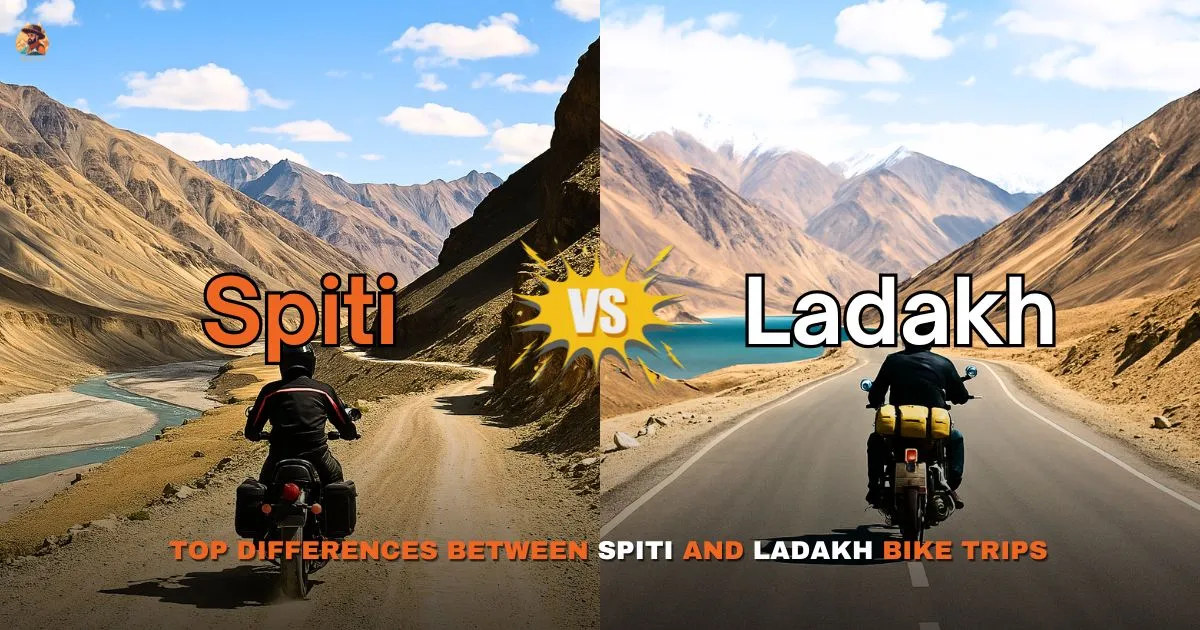
Many riders get confused when they compare Spiti vs Ladakh bike trip differences for their first Himalayan ride. Both routes look beautiful, but each one gives a very different experience. This guide helps you understand the real road conditions, weather, culture, and altitude challenges so you can pick the route that matches your travel style.
What happens when Mountaintop calls to you in two voices? On one side, you have the serenity of Spiti. On the other side, you see the great landscapes of Ladakh. In the middle, you become confused trying to decide what your perfect adventure is. That is why this guide provides the top differences between Spiti Valley and Ladakh bike trips. Whether you dream about a Spiti bike trip or imagine yourself riding in magnetic hills and blue lakes, this comparison will help you to pick out the journey that shot are looking for.
Top Differences Between Spiti Riders Valley And Ladakh Bike Trips
Before choosing one of these two famous routes, it is important to know how truly they differ in the aspects and overall riding experience. Both places are amazing in terms of beauty, but each one offers you a very different kind of adventure.
1. Road Conditions and Difficulty
Riders often feel the biggest difference between Spiti and Ladakh on the road itself. When I speak with travelers, they always mention how the terrain changes their whole riding mood. This small overview will help you understand what kind of road experience you will face before you start your journey.
Spiti Valley
The roads are rough and broken, and are often just dirt and steep paths. Water crossings, loose gravel, and sudden landslides make the crossing an unpredictable one. This is a road where riders have to be alert at every turn.
Ladakh
Ladakh has a mixed kind of road: smooth and bumpy. While having a Leh Ladakh bike trip on the Leh-Manali Highway, you will feel like you are riding on a ribbon laid over mountains. But the high passes, like Khardung La and Chang La, bring sharp curves, thin air, and sudden weather changes. The conditions change constantly and make the ride exciting but demanding.
2. Weather and Climate
Weather plays a huge role in every mountain trip. Many new riders do not expect how fast conditions change in both regions. I have seen travelers facing sudden cold winds, bright sun, and surprise snowfall on the same day. This overview gives you a simple idea of how the weather behaves in Spiti and Ladakh.
Spiti Valley
In Spiti, it remains cold for the greater part of the year. Mornings are cool even in the summer, and the wind blows. In the winter, the entire valley gets covered in snow, and roads are blocked. Temperatures can drop very quickly and especially at night.
Ladakh
Ladakh is cold, bright, and unpredictable. Days may be warm in the strong sun; however, temperature falls sharply at night. Wind shifts rapidly, especially when you are on the tops of passes. Snow comes at any time (including summer times too). Ladakh, as a tourist location, in contrast to Spiti, with more tourists visiting and is open for a longer season.
3. Culture and Lifestyle
The beauty of mountain trips is not only in the roads. It is also in the people you meet and the places where life moves at its own rhythm. Spiti and Ladakh carry two very different cultural moods. This overview helps you feel the energy of both regions before you choose your route.
Spiti Valley
Spiti’s culture is quiet, old, and closely linked to Tibetan Buddhism. The villages are small, slow-paced, and tranquil. Monasteries cover the land, and people follow the old rituals. When you meet the locals, their warmth is felt even in the coldest weather.
Ladakh
The culture in Ladakh is lively, colourful, and welcoming for visitors. It is a combination of the Tibetan and modern life. Festivals are big, monasteries are active, and every village has a story. Markets are thriving with tourists, and traditions go hand in hand with tourism.
4. Altitude Challenges
Altitude is the first real test for any rider in the Himalayas. Both routes rise high, but each one affects your body differently. I always tell riders to respect the height and move slowly. This overview explains what type of altitude challenge you should expect on these journeys.
Spiti Valley
Most of the valley is higher than 3,800m, so the air is thin as soon as you are there. Your body needs time to make adjustments, and riders often feel short of breath when riding or walking. Getting accustomed to the altitude is important, and keeping hydrated is important. Though this is difficult, it gives Spiti its serene charm.
Ladakh
Surprise altitude leaps are given by Ladakh. One minute you are on a smooth road and the next you are climbing a pass over 5,000 metres. Breathing becomes more difficult and headaches are common by rushing. Getting used to the altitude slowly and carefully. The sharp ups make the journey thrilling, but physically demanding.
5. Attractions and Photo Spots
Every rider loves a route that feels picture-perfect. When I speak with travelers, they always share stories about the colours, the silence, and the grand views. Spiti and Ladakh both offer scenes that stay in your mind for years. This overview helps you understand the kind of moments and photo spots you will see on each side of the Himalayas.
Spiti Valley
Spiti is beautiful as it is untouched. Old monasteries sit quietly on the cliffs, villages gleam in the soft sun, and simultaneously with every turn, the road opens a natural frame. Photography here is about the mood: warm light, brown mountains, prayer flags in motion, frozen rivers, and small white houses.
Ladakh
Ladakh is like a playground for the photographer. Every corner offers spectacular landscapes: turquoise lakes, large passes, white stupas, and endless open roads. Colours are more vivid, shadows are darker, and skies are deeper. The scenery has the look of paintings, especially around Pangong Tso and Nubra.
6. Accessibility and Connectivity
Practical travel matters a lot when you ride in high mountains. Many riders ask me if they will get a network or if the route will stay open. Both regions have very different levels of access and comfort. This overview will give you a clear idea of how easy it is to reach Spiti or Ladakh and what you can expect during your journey.
Spiti Valley
Spiti requires patience to get here. Roads are accessible only for a few months of the year, and access is weather-dependent. Public transport is limited, so private vehicles are often safer. Phone signals are not present in many places, and the internet is basic.
Ladakh
Ladakh is easier to reach, it has an all-year-round working airport, and a long tourist season. Roads are not closed for long, and buses and taxis are available. Networks work well in most areas except high passes. Leh has cafes, accommodation, and good connectivity, which makes travelling easier. Riders should wear layers of warm clothing even during the warmest months. A quick guide on how to pack for a winter trip in India can also help you prepare better.
7. Budget Differences
Budget planning is a key part of any long ride. I meet riders who spend less and still enjoy the journey, and I meet riders who plan for comfort and pay more. Spiti and Ladakh offer very different cost patterns. This overview explains how your money moves on both routes so you can plan your trip with confidence.
Spiti Valley
Spiti is generally cheaper. Lodging is simple but cheap, food is basic and affordable, and daily costs are low. Fuel costs are usually the biggest part of the budget due to long distances and poor petrol stations. The simplicity makes the trip peaceful, meaningful, as well as affordable.
Ladakh
Ladakh is slightly costlier due to the higher number of tourists in the state. Lodging is from budget to luxury, and food is dependent on the area. Fuel and permits raise costs. Activities like camel ride, lake visit, and adventure sports also add to the budget. Many riders also explore the top touring adventure bikes in India for a safer mountain ride. However, Spiti’s challenge is what makes it unforgettable.
Spiti vs Ladakh Bike Trip Comparison Table
| Category | Spiti Valley | Ladakh |
|---|---|---|
| Road Conditions | Rough, narrow and challenging | Mixed roads, smoother highways |
| Altitude Pattern | Gradual rise | Sudden high passes |
| Weather | Cold and windy | Cold, bright and unpredictable |
| Culture | Quiet, traditional and slow | Lively, colourful and active |
| Budget | Cheaper overall | Slightly higher |
| Accessibility | Limited season and weak network | Longer season and better connectivity |
| Best For | Raw adventure lovers | Riders who enjoy wide landscapes |
Conclusion
Going to Spiti and Ladakh is not simply just a trip; they are the two hearts of the Himalayas. The top differences between Spiti Valley and Ladakh bike trips are that one utters soft voices, while the other one sings out loud to the wind. Whether you go to the quiet calm of Spiti or the big drama of Ladakh, both will change you a little, make you soft a little, and make you remember its skies even after you finish travelling. In the end, the best place is the one to which you are connected because of your soul, whether it is Spiti’s slow calm or Ladakh’s wild freedom.
You can also check some of the best Himalayan treks for beginners for more mountain inspiration. This guide will help you decide the kind of journey that suits you and your style.
FAQs About Spiti vs Ladakh Bike Trips
Ladakh usually has better, wider roads, hence it is a bit easier for beginners. Spiti requires more skill since the paths are narrow and rugged.
Yes, but only if you have 12-15 days and you are comfortable with long travel hours. Otherwise, choose a single place and find out all about it.
Ladakh has more hotels and guesthouses. Spiti primarily has homestays with a raw and real mountain experience.
Both of these places are high in altitude. Ladakh has very high passes like Khardung La. Spiti is also high, but it goes up gradually; therefore, it is easier to adjust to the altitude.
Both are breathtaking, Spiti for its feeling of quietness and Ladakh for its powerful skies and colourful landscapes.
The best time for a Spiti bike trip is from May to September. The roads stay open and the weather remains stable during these months.
A Ladakh bike trip usually costs between 25,000 and 40,000 for a 6 to 7-day itinerary, depending on stay, food, and permits.
Spiti needs steady fitness because the terrain is rough. Ladakh needs stronger stamina because the altitude rises very quickly.
The network is limited in Spiti. BSNL works in many areas. Jio works in a few towns. Many villages have no signal.
Yes, you need permits for Nubra Valley, Pangong Lake, and some inner-line areas. You can get them in Leh.
Ladakh feels safer for solo riders due to a better network and more tourist traffic. Spiti is remote, but homestays are very welcoming.
Kaza is the main fuel point in Spiti. You should plan your refuel stops because long stretches have no pumps.

Hi, I am Manoj Kumar, the voice behind Trip Guru Go. I am a travel researcher, SEO content expert, and founder of this blog. With over 12 years of experience in digital travel research, I simplify complex destinations into real, helpful, and trustworthy guides.
Every article I write is backed by local sources, real traveler experiences, and deep fact-checking. Even if I have not visited every place personally, I never share anything without strong on-ground insight.
I do not sell travel packages or promote anything paid. My only goal is to help you travel smarter — with zero fluff, 100% honesty, and a deep focus on your safety and experience.