
Hidden inside the narrow lanes of Mehrauli, the Yogmaya Temple feels like stepping into another time. Just behind the grand walls of Qutub Minar, this small Shakti shrine carries the quiet pulse of Delhi’s oldest faith. When I first walked here, the sound of traffic faded into temple bells and faint chants. The air smelled of incense. The old steps led me to an energy both ancient and alive.
In this guide, I will share the history, mythology, timings, nearest metro routes, festivals, and personal tips from my visit to Yogmaya Temple, Mehrauli. If you are planning your first trip, I want you to know not just how to reach, but also how it feels to sit in silence here.
If you are exploring more sacred sites across the city, do not miss the Famous Temples in Delhi.
Full Day Temple Tour in Delhi
 Group Trip
16 Oct 2026
Group Trip
16 Oct 2026
Full-Day Temple Tour in Delhi
Why Yogmaya Temple Mehrauli Matters
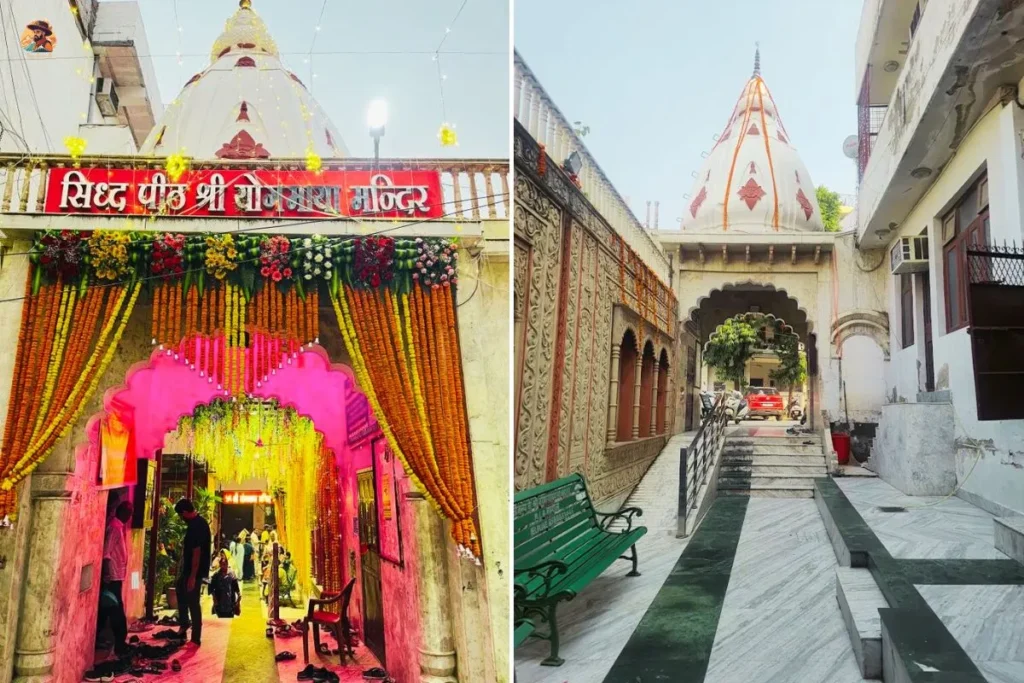
I still remember turning into Mehrauli’s cramped lanes. Scooters brushed my arm, a shopkeeper shouted “dus ka bees,” and for a moment I thought — maybe I had lost the way. Then a small arch appeared. The entrance of Yogmaya Temple.
Inside… Everything slowed down. Bells rang softly, chants floated from the sanctum, and the smell of marigold garlands filled the courtyard. I stood still. Maybe it was silence. Maybe it was fragrance. Both calmed me.
If you are planning to visit, here is why this temple matters:
- Just steps away from Qutub Minar, yet tucked into quiet lanes.
- Locals believe it is among the oldest Shakti temples in Delhi.
- No flash. No grandeur. Just bells. Just flowers. Just faith.
👉 Tip: Visit in the morning. The crowd is thinner, and you may even find space to sit in silence for a while.
History & Legends of Yogmaya Temple
The stories here do not sound like history lessons — they feel like memories people still carry. A pujari told me the temple dates back to the Mahabharata period. The Pandavas, after the war, rebuilt it for Yogmaya, Krishna’s sister. His words were simple, almost casual, like a grandfather passing down an old tale.
Centuries later, Delhi changed rulers again and again. Still, this shrine remained. During the Mughal era, Emperor Akbar encouraged the festival of Phool Walon Ki Sair. Hindus offered floral canopies here, while Muslims carried the same to the nearby dargah. Two faiths, one celebration. I saw posters of the same festival pinned to chai stalls even today — proof that the tradition never died.
Think of the temple’s past in layers:
- Mythology: Yogmaya Devi, the power of illusion, is linked to Krishna’s birth.
- Pandavas: Rebuilt after the Kurukshetra war.
- Mughals: Akbar’s time brought Phool Walon Ki Sair, still alive in Mehrauli.
- Now: One of the few ancient temples that Delhi’s empires could not erase.
👉 If you come during Phool Walon Ki Sair (September), keep your evening free. The lanes glow with lights and flower canopies, and the temple feels like a living festival ground.
Inside… just stones. But heavy. Whispers. Prayers. Silence.
Mythological Story of Yogmaya Devi
When I sat in the courtyard, an old pujari leaned closer and said, “Do you know why Krishna survived? Because Yogmaya fooled Kansa.” His tone was half-story, half-warning.
Who is Yogmaya?
She is described in the Puranas as Krishna’s sister. The goddess of illusion. But honestly, the way the pujari said it — it felt less like mythology and more like Delhi gossip that had been alive for centuries.
Is Yogmaya the same as Parvati?
I asked this too. He shook his head, “Parvati is Shiva’s. Yogmaya is Krishna’s.” Simple, almost like he was correcting a child. A younger devotee nearby added, “Parvati is the mother, Yogmaya is the protector.”
Is Yogmaya another form of Durga?
One old woman whispered to me, “For us, she is Durga. Who else can fight demons?” She was not quoting scripture. She was just sharing faith the way you share tea with a neighbour. One woman laughed softly before answering, as if I had asked the obvious.
Did Yogmaya have a husband?
When I asked, another priest laughed. “Beta, Maya doesn’t marry. She already tricks the whole world.” Everyone around smiled, and I realised the answer was never about facts. It was about devotion.
👉 The temple does not give one straight version. It hands you many. And the real story is the one you carry out with you.
Yogmaya Temple Timings & Aarti Schedule
I once arrived just after noon. The gate was locked, and three women sat outside under the neem tree, waiting with flower baskets. One of them smiled and said, “Beta, Maya bhi rest karti hai dopehar ko.” I laughed, and for the first time, timings did not feel like rules — they felt human.
⏰ Here’s what I noted down on my second visit:
- Morning Darshan: 5:00 AM – 12:00 PM → First aarti around sunrise.
- Afternoon Break: 12:00 PM – 4:00 PM → Doors closed, courtyard empty.
- Evening Darshan: 4:00 PM – 9:00 PM → Evening aarti with lamps.
👉 I once joined the evening aarti — the conch shook my chest, the lamps flickered against old stone, and even strangers hummed in rhythm.
Seasonal highlights:
- Navratri: Extra bhajans, open till late at night. Crowds swell, but the energy feels electric.
- Phool Walon Ki Sair (September): Aarti timings adjust for the flower canopy procession. The whole lane lights up.
Tips from my visit:
- Come at sunrise if you want silence. I found barely a handful of devotees then.
- Come at sunset during Navratri if you want an atmosphere — the temple feels like it is glowing from within.
How to Reach Yogmaya Temple, Mehrauli
I began my visit on the Yellow Line of the Delhi Metro. The nearest stop is Qutub Minar Metro Station, the best landmark for Shri Yogmaya Temple, Mehrauli.
From Gate 1, it is a 1.2 km walk (12–15 minutes) through Mehrauli’s lanes. Scooters zipped by, chai stalls filled the air with cardamom, and one school boy pointed me left when I looked confused. “Mandir us gali me hai uncle,” he said shyly. That walk itself felt like a small slice of old Delhi.
Quick distances and routes:
| Route | Distance & Time | Notes |
| Qutub Minar Metro → Temple | 1.2 km / 12–15 min walk | Lanes with shops, chai stalls, and traffic |
| Qutub Minar Monument → Temple | ~500 m from the back gate | Easy to ask locals for directions |
| Mehrauli Bus Stand → Temple | ~300 m / 4 min walk | DTC routes connect here |
🚖 Choose Your Ride
- Walking: Best in the morning or evening. Peaceful, scenic, but the lanes are narrow.
- Auto-rickshaw: ₹30–₹50 from Qutub Metro or Saket. Drops close to Temple Lane.
- DTC Buses: Many routes (413, 34, 356, 725) stop at Mehrauli Bus Stand. From there, it is a short walk.
- Cabs (Ola/Uber): Drop you near the lane, but cars cannot enter inside. Expect to walk a little.
👉 I once paused for chai midway — honestly, the walk felt shorter after that break.
Festivals & Celebrations at Yogmaya Temple
I still remember visiting in September. The sky was heavy with monsoon clouds, and the lanes of Mehrauli smelled of wet earth. Outside Yogmaya Temple, I was handed a floral pankha. Holding it, I felt like Delhi’s heartbeat was wrapped in petals.
✨ Navratri Pooja & Bhog
Here’s what actually happens if you land up during Navratri:
- When: Twice a year – Chaitra (March/April) & Ashwin (Sept/Oct), dates vary by lunar calendar.
- Special Days: Maha Sasthi, Saptami, Ashtami, Navami (the peak).
- Offerings: Bhog includes halwa, puri, kheer, and milk. Garlands of marigolds are common.
- Atmosphere: Lamps glowing, rhythmic chants, families waiting patiently in long queues that start before sunrise.
👉 I once joined during Ashtami. The chants rose like waves, halwa smell filled the air, and I felt both safe and small in the crowd.
🌸 Phool Walon Ki Sair – Delhi’s Floral Festival
Every September (lunar dates vary), Mehrauli bursts into color during this interfaith celebration. A procession begins at Qutub’s dargah and winds its way into Yogmaya Temple, carrying pankhas made of flowers.
Locals say the tradition began under Emperor Akbar Shah II. Later, Nehru revived it, and since then, Delhi has never missed a year.
👉 I stood in the crowd watching priests, flower-sellers, and children walk side by side. The pankha passed hand to hand, drums and laughter filled the lane. For a moment, the city felt united.
🌙 Local Traditions
Even beyond festivals, Yogmaya Temple keeps a steady rhythm of devotion:
- Daily Rituals: Mata Snanam (idol bath), bhajans, and flower offerings.
- Evenings: Families gather near the marble well, offering small bowls of flowers and lighting diyas.
👉 One evening in Kartik month, I saw two women quietly place marigolds on the steps, whispering prayers only they and the goddess could hear.
Nearby Attractions from Yogmaya Temple
One of the best things about Yogmaya Temple is how much history surrounds it. Step outside the courtyard, and you can walk into centuries of Delhi’s story within minutes.
🌟 Qutub Minar (Walking Distance)
From the temple lane, you can already glimpse Qutub’s tall silhouette. It is hardly a 7–10 minute walk to the back gate. I once looked up from Yogmaya’s courtyard and saw the minaret peeking above the rooftops — like history leaning in to greet the present.
🏛️ Mehrauli Archaeological Park
Just across the road lies a spread of ruins and greenery that often surprises first-time visitors. Covering nearly 200 acres, this park feels like a forgotten open-air museum.
What you will find inside:
- Stepwells: Rajaon ki Baoli, with mossy steps leading into still water.
- Tombs & Pavilions: Mughal-era domes and crumbling arches hidden under trees.
- Paths: Quiet trails where peacocks sometimes wander.
👉 I remember walking here after the rain. The stones were damp, and the silence felt heavier than the city outside. You can also visit the Kalkaji Temple in Delhi for another glimpse of Shakti worship in the capital.
🕌 Jamali Kamali Mosque & Tomb
A short auto ride (or 15-minute walk) brings you to Jamali Kamali. The mosque is simple but calming. At the gate, a young boy grinned and said, “Bhoot bhi rehte hain yahan.” I laughed, unsure if he was warning me or just teasing. Inside, it felt more like a resting place than a haunted one.
🛍️ Local Markets & Food in Mehrauli
Mehrauli’s bazaar lanes are narrow but buzzing. Shops sell garlands, bangles, and incense. Street stalls tempt you with hot pakoras, samosas, and jalebis. After evening aarti, I once had a plate of aloo tikki dripping with chutney — messy fingers, full heart.
Travel Tips for Tourists (Local & Foreign)
After several visits, I have learned that a few small things can make the trip easier and more peaceful.
👗 Dress Code & Temple Etiquette
- Wear modest clothes covering shoulders and knees.
- Shoes must be left outside; a small stall keeps them safe for a few rupees.
- Keep your voice low inside. Silence is seen as respect.
👉 I once saw a local woman gently drape a shawl over a foreign visitor in shorts — a reminder that warmth and hospitality live here too.
📅 Weekend vs Weekday Crowd
- Weekdays: Quieter, especially mornings before 10 am.
- Weekends: Saturday evenings after 5 pm are the busiest; lanes get jammed with autos and market stalls.
- Festivals: During Navratri, queues begin even before sunrise. Phool Walon Ki Sair in September fills the whole neighborhood with processions.
👉 I once found myself squeezed between a flower vendor and a scooter in the Saturday evening rush — patience is the only way through.
🛡️ Safety Tips & Photography Rules
- Lanes are narrow, with autos and scooters weaving through — walk alert.
- I clicked a few shots outside, but inside the pujari frowned. Cameras down.
- Keep small cash handy for prasad and shoe-keeping; cards or UPI rarely work.
👉 I always tuck my phone deep into a sling bag here. It leaves my hands free to carry flowers without worry.
✨ With these little steps, your visit feels smoother, and you can focus on the temple’s peace instead of small hassles.
Yogmaya Temple Address, Contact & Map
- 🕌 Temple Name: Shri Yogmaya Temple, Mehrauli
- 🏠 Address: Kalka Das Marg, Mehrauli, New Delhi – 110030, India
- ☎️ Contact Number: +91-11-2656 2355 (best to call mornings)
- 🗺️ Google Maps: Shri Yogmaya Temple Location
👉 Tip: In Mehrauli, just follow the lane with garland and prasad shops — it always leads straight to the temple gate.
Conclusion – Why Yogmaya Temple Is Delhi’s Spiritual Heritage Gem
For me, Yogmaya Mandir is Delhi’s quiet heartbeat — a place where history and faith meet. I still remember holding a floral pankha during Phool Walon Ki Sair, watching devotees and musicians walk together. For a while, Delhi’s noise just stopped. Only chants. Only unity. If you visit, sit near the marble well, listen to the chants, and let the calm follow you long after you leave.
FAQs about Yogmaya Temple, Mehrauli
Who built the Yogmaya Temple in Mehrauli, Delhi?
It is believed to date back to the Mahabharata era, built by the Pandavas. Later, it was rebuilt during the Delhi Sultanate and Mughal periods.
Which is the nearest metro station to Yogmaya Temple?
The nearest is Qutub Minar Metro Station (Yellow Line), about 1.2 km away. It is a 12–15 minute walk or a short auto ride.
What are the Yogmaya Temple timings?
Morning: 5:00 am – 12:00 pm
Evening: 4:00 pm – 9:00 pm
👉 Timings may extend during festivals like Navratri.
How far is the Qutub Minar from the Yogmaya Temple?
Just 500 metres from the back gate of Qutub Complex. Walking takes around 7–10 minutes.
Are Yogmaya and Durga the same goddess?
Many believe Yogmaya is a form of Durga, while others view her as a distinct Shakti. A devotee once told me, “For us, she is Durga Mata herself.”
What festivals are celebrated here?
The biggest are Navratri and Phool Walon Ki Sair. Daily rituals include bhajans, aarti, and Mata Snanam.
Is it safe for families and foreign tourists?
Yes, it is safe and welcoming. Weekends get crowded, so keep valuables secure. Locals often help foreign visitors with directions and shawls for modesty

Hi, I am Manoj Kumar, a travel researcher and SEO content expert writing for Trip Guru Go, focused on Delhi and nearby travel destinations.
Being from Delhi NCR, I understand the travel preferences, routes, budgets, and experiences that travelers from this region actually look for. Every article I write is backed by local insights, real traveler experiences and detailed research to provide accurate and useful travel information.