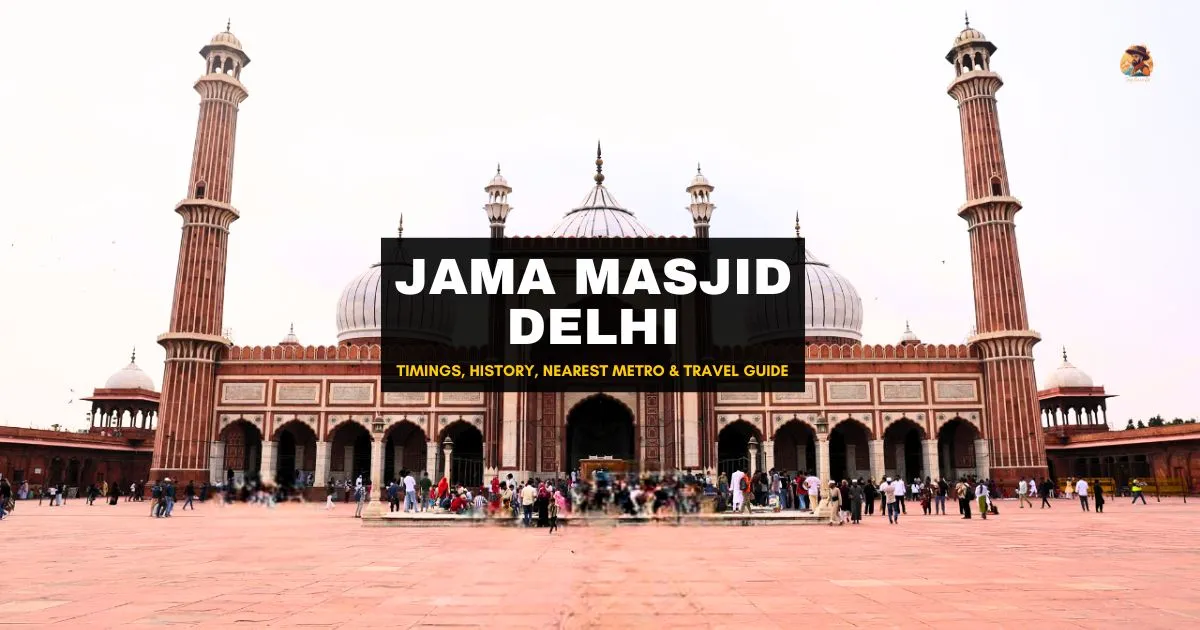
Jama Masjid Delhi is not just a monument; it is the soul of Old Delhi. Built by Shah Jahan in the 17th century, this grand mosque continues to draw thousands of people every day. From the cool marble courtyard to the tall minarets overlooking Chandni Chowk, everything here tells a story of faith and Mughal glory.
In this guide, I will share the history of Jama Masjid, its timings, the nearest metro station, entry rules, ticket details, and even personal tips on climbing the minaret or enjoying the evening aarti vibes. If you are visiting Delhi for the first time, this complete travel guide will help you explore Jama Masjid with ease and emotion.
Introduction – Why Jama Masjid Matters
The first time I saw Jama Masjid, I had just stepped out of Chawri Bazar metro. The lanes were packed with cycle-rickshaws, the smell of kebabs mixed with incense, and hawkers shouted “do rupaye ka nimbu paani.” Then suddenly, the domes appeared above the rooftops — white marble against Old Delhi’s dust and chaos.
Inside, the noise melted. Pigeons fluttered, the marble felt cool under my bare feet, and the azaan echoed across the walls. For a moment, Old Delhi slowed down.
It is India’s largest mosque, big enough to hold more than 25,000 people. Shah Jahan built it in the 1650s, the same as the emperor who gave us the Taj Mahal and the Red Fort. Even today, the azaan rises here five times a day, and every time it does, pigeons scatter into the sky like they are part of the prayer.
👉 If you want to feel Delhi’s heartbeat, come in the morning. The marble is cool, the crowd is thin, and the first azaan feels like it is opening the city’s day just for you.
History of Jama Masjid Delhi
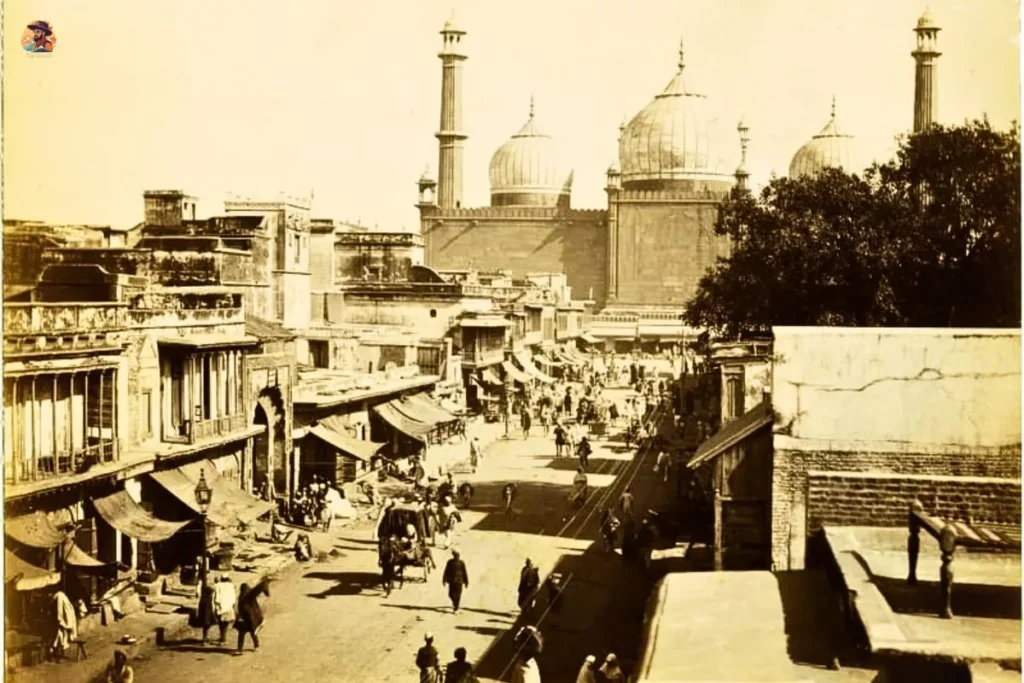
History here does not read like a textbook. It is carved into the red sandstone, layered into the domes, and whispered by locals.
Shah Jahan began building the Jama Masjid in 1650. For six years, hammers echoed and chisels struck. Over 5,000 artisans carved stone day after day. Red sandstone blocks. White marble stripes. Money flowing — almost a million rupees by the time it finished in 1656.
A guide once told me, “The Taj Mahal was for love. But this… this was for faith.” That line stayed with me. I stopped listening for a moment, just counting pigeons circling above the domes. History felt alive in their wings.
Compared to Agra’s Moti Masjid, this place feels wide open, almost restless. Moti Masjid hides quietly inside Agra Fort. Jama Masjid stands tall, crowded, open to the sky. Across the road, the Red Fort watches like a twin brother, both monuments born of the same emperor’s vision.
👉 If you touch the walls on a hot afternoon, you will feel their warmth. Rough, heavy, as if the stone itself remembers everything it has witnessed.
Jama Masjid Delhi Architecture & Design Features
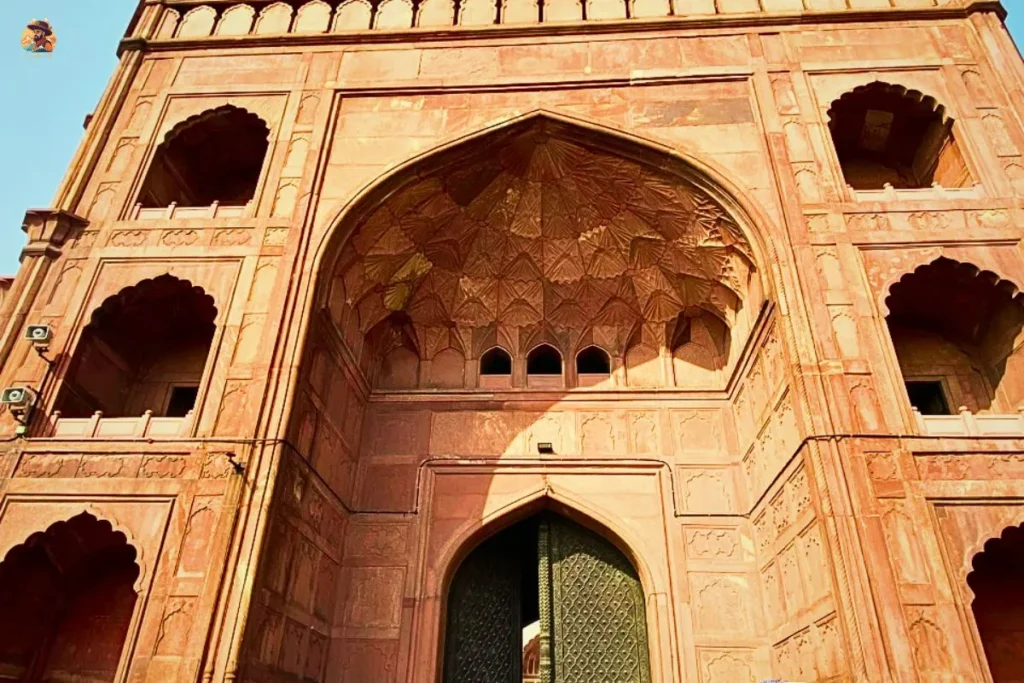
Stepping into the Jama Masjid’s courtyard feels like stepping into another scale of life. The open ground can hold nearly 25,000 worshippers, and even on a quiet weekday morning, the emptiness itself felt grand — like a vast white prayer carpet stretched under the sky.
The mosque’s beauty stands out in small details that many visitors miss:
- Three domes shining with white marble and black stripes.
- Tall sandstone arches frame the vast courtyard.
- Intricate marble inlay near the mihrab, glowing in sunlight.
- Everyday moments — a pigeon landing on the dome, echoes of footsteps, or the soft play of morning light.
After rain, the marble courtyard shines like a mirror, reflecting the domes and the sky above — a sight that makes silence feel sacred.
🏴 Climb the South Minaret of Jama Masjid
For the best view, climb the southern minaret. A small entry fee (₹100–₹200, higher for foreigners) is charged. The spiral staircase is narrow and dimly lit. I brushed my shoulders against the walls and even stopped halfway to let a child squeeze past.
When you finally step out, the view feels unforgettable:
- The Red Fort is glowing in the east.
- Chandni Chowk is buzzing like an ant trail below.
- The Jama Masjid courtyard spreads like a glowing prayer carpet in the sun.
👉 I paused there longer than I expected. For once, Old Delhi looked calmer, almost peaceful, as if centuries of noise had frozen in one still frame. That moment alone made the climb worth it.
From the southern minaret, the sunset paints Delhi in shades of gold — the domes shimmer, the Red Fort glows, and the azaan drifts through the warm evening air.
Best Time to Visit Jama Masjid Delhi

The best time to visit Jama Masjid Delhi is early morning (7:00 AM to 9:00 AM). The marble feels cool, the pigeons fly over the domes, and the azaan creates a peaceful start to your day. It is calm, spiritual, and perfect for slow travelers.
Evenings are another beautiful time to visit. Around 5:00 PM to 6:30 PM, the sandstone glows golden, and the lanes around Meena Bazaar fill with food stalls and evening prayers. It is ideal for photos, chai breaks, and watching the sunset over Old Delhi.
To plan smartly:
- ☀️ Morning: Peaceful, best light for photography.
- 🌆 Evening: Vibrant, great for food and atmosphere.
- 🔥 Avoid Noon (Summer): Too hot and crowded.
- 🌙 Fridays & Ramadan: Festive, but reach early to avoid rush.
👉 Travel Tip: Morning for calm. Evening for color. Choose your time based on mood — both offer a glimpse of Old Delhi’s soul.
Jama Masjid Timings & Entry Rules
My first visit was at noon — mistake. The courtyard was full, prayers echoed, and I barely found space to stand. Later, I learned the rhythm.
🕰️ Daily Timings
Here’s what I figured out after a few visits (and a few mistakes):
- Morning: Opens around 7:00 AM.
- Afternoon: Midday prayers fill the courtyard.
- Evening: Closes at 6:30–7:00 PM, depending on the season.
- Friday: Crowds swell; arrive early if you want space.
👉 One evening, I arrived at 6:45, only to see the guard already pushing the gates shut. Since then, I have always tried to be 30 minutes early.
🎟️ Tickets & Camera Fee
- Entry: Free for everyone.
- Camera Fee: Around ₹300 if you carry a camera inside.
- Minaret Climb: ₹100–₹200 (varies for Indians and foreigners).
During one of my visits, I hesitated to pull my camera out, worried about the fee. The guard smiled and said, “Bas ticket le lo, photo jitna marzi kheecho.” That small exchange made the place feel more welcoming.
🕌 Dress Code & Etiquette
- Shoulders and knees must be covered. Shawls are often available at the gate.
- Shoes must be left outside. A small stall keeps them safe for a few rupees.
- Keep your voice low, especially during prayer times.
👉 One afternoon, I saw a local woman hand her dupatta to a tourist in shorts. The visitor smiled awkwardly, and the woman just said, “Now you are ready.” It felt like Delhi’s hospitality wrapped in cloth.
🌙 Ramadan & Friday Vibes
- During Ramadan, I sat by the steps at iftar — dates, samosas, and biryani shared with strangers.
- Fridays are the busiest. The azaan rises louder, pigeons scatter, and the mosque breathes with thousands of people at once.
How to Reach Jama Masjid Delhi
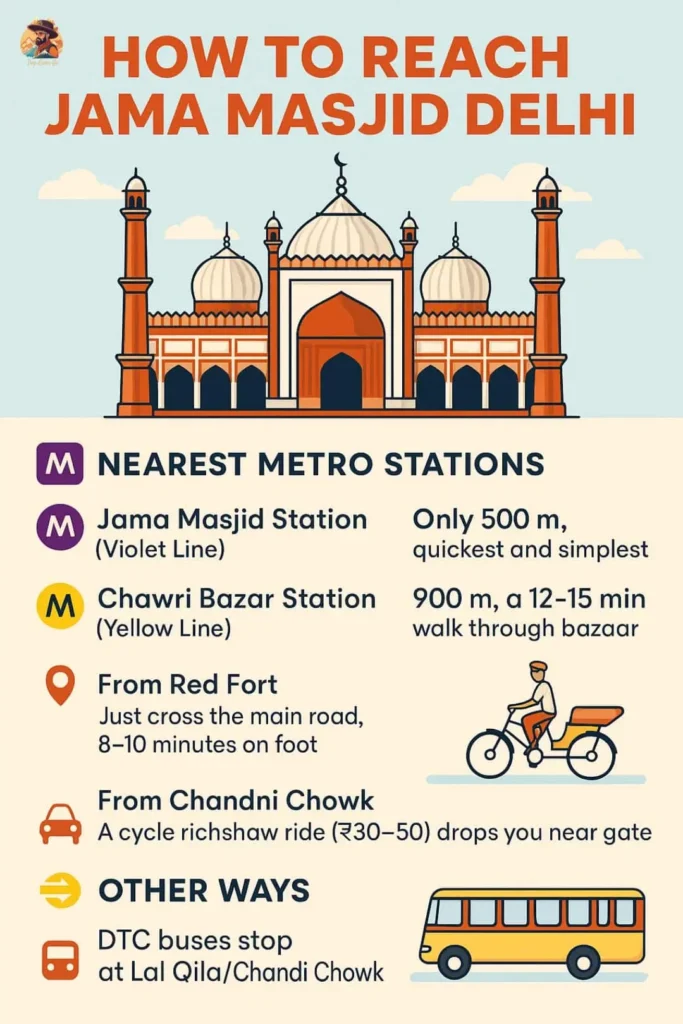
The first time I came to Jama Masjid, I got down at Chawri Bazar Metro. The moment I stepped out, the lanes pulled me in — shops frying jalebis, the smell of agarbatti, and rickshaws weaving like they had no brakes. I almost missed the turn because I was staring at a shop full of brass lamps.
🚇 Nearest Metro Stations Jama Masjid:
- Jama Masjid (Violet Line) → Only 500 m, quickest and simplest.
- Chawri Bazar (Yellow Line) → 900 m, a 12–15 min walk through Old Delhi’s busiest bazaar.
👉 Tip: If it is your first visit, choose Chawri Bazar. Yes, the walk is chaotic, but it sets the mood — you smell food, hear shopkeepers shout “do rupaye ka topi le lo!”, and then suddenly the mosque’s domes rise ahead of you.
- From Red Fort: Just cross the main road, 8–10 minutes on foot.
- From Chandni Chowk: A cycle rickshaw ride (₹30–₹50) drops you near the gate. Once, my rickshaw got stuck in a traffic jam of goats and scooters. I laughed, the driver shrugged, and we waited till the animals moved. That’s Old Delhi.
- Other Ways:
- DTC buses stop at Lal Qila/Chandni Chowk; from there, it is a short walk.
- Cabs (Ola/Uber) only go till the outer gate; the last few hundred meters are always on foot.
- DTC buses stop at Lal Qila/Chandni Chowk; from there, it is a short walk.
👉 Best Route: Walk through Meena Bazaar. Perfume sellers wave you in, kebab smoke lingers in the air, and when you finally see Jama Masjid’s steps, it feels like you have earned the view.
Jama Masjid Market & Local Shopping
Meena Bazaar outside Jama Masjid is not just a market; it is Old Delhi talking to you.
- Market Timings: Opens around 10:00 AM till late at night.
- Closed Day: Most shops shut on Sunday, though a few food stalls still run.
What you find here:
- Small glass bottles of attar (perfume). One shopkeeper once dabbed rose oil on my wrist and said, “Yeh Dilli ka asli khushboo hai.”
- White skull caps and colorful prayer beads.
- Spices are packed in paper cones.
- Dupattas and embroidered fabrics are stacked high in tiny shops.
👉 My Tip: Mornings are calmer, and shopkeepers bargain less aggressively. Evenings are fun, but the crowd can push you shoulder to shoulder. One evening, I got lost in the rush and stopped at a chai stall just to breathe.
Jama Masjid Food & Ramadan Experience
If you walk out of Jama Masjid hungry, trust me, you missed the real story. The air here is thick with smoke from grills, the sizzle of oil, and shouts of vendors juggling ten orders at once.
🍲 Karim’s – The Legendary Stop
I still remember waiting outside Karim’s. Twenty minutes in line, sweating in the heat. When my nihari finally arrived, the waiter rushed me, “Jaldi khao, agle log wait kar rahe hain.” The curry was rich, spicy, and heavy with history. Even the rush felt part of the experience.
🍢 Al Jawahar & The Kebabs
Just across the lane, Al Jawahar’s kebabs are softer than you expect. The green chutney burns for a second but keeps pulling you back. I once ate standing outside, my plate balanced on a parked scooter. Messy, but unforgettable.
🍬 Sweet Treats
Street stalls tempt you with jalebis dripping in syrup and phirni cooling in clay pots. I once held a cup of phirni so cold my fingers tingled, but the first spoon soothed the heat of Delhi instantly.
🌙 Ramadan Evenings
Ramadan transforms the whole lane. Just before sunset, families sit with dates and water bottles in their hands. The azaan begins, and everyone breaks their fast together. A stranger once passed me a date with a smile — no words, just warmth. Later, the streets lit up with kebabs, biryani, and sheer khurma, stretching past midnight.
👉 Tips for Travelers
- Pick the busiest stalls — food finishes fast, so freshness is guaranteed.
- Carry tissues and water; eating here is always a little messy.
If you are a foreign visitor, locals often guide you. I once saw a vendor gently suggest a mild kebab to a tourist so he would not burn his tongue.
Ramadan and Eid Celebrations at Jama Masjid
During Ramadan (Ramzan ke waqt), Jama Masjid turns into a sea of devotion. At sunset, thousands sit with dates and water, waiting for the azaan. I still remember a stranger passing me a date silently, smiling — no words, just warmth.
- Ramadan Taraweeh: Night prayers echo through the vast courtyard, candles and lamps glowing softly.
- Iftar Sharing: Locals hand food even to strangers — a plate of biryani, a handful of pakoras.
- Eid Morning: The mosque overflows with worshippers; white caps (topis) fill every corner.
- Chand Raat (Night Before Eid): Meena Bazaar glitters with bangles, henna stalls, and sweets until midnight.
👉 Tip: Arrive at least one hour before sunset during Ramadan. Crowds grow fast, and getting a quiet spot becomes difficult.
Photography Guide for Jama Masjid (Best Times & Spots)
The photos of Jama Masjid do not just stay in your camera — they stay in your memory. During an early morning visit, pigeons flew together above the empty courtyard. For a moment, I forgot to click and just watched.
- Courtyard Shots: Capture the vastness with the domes and arches framing the minarets.
- Sunrise Calm: Early morning gives soft light and very few people — perfect for wide shots.
- Golden Hour (Evening): The domes glow in warm sunlight, making the best portraits and silhouettes.
- जामा मस्जिद दिल्ली की तस्वीरें (Hindi searches): These are most beautiful at dusk when lamps light up the mosque.
- Rooftop Cafés: From nearby rooftops in Meena Bazaar, you can sip chai and frame the minaret against the Old Delhi skyline.
👉 Insider Note: One evening, I paused at a rooftop café with a hot cup of chai. Watching the minaret catch the last ray of sunlight, I almost forgot to take the shot — but that pause made the photo even better.
🕊️ Jama Masjid Photography Tips
If you love photography, reach early morning (7 AM–8 AM) or just before sunset (5 PM–6 PM).
The light is soft, and the marble shines beautifully.
Best spots for photos:
- From the southern minaret, capture the full view of Old Delhi and the Red Fort.
- In the courtyard, click reflections after rain or during golden hour.
- From Meena Bazaar rooftops, frame the domes with chai or kebab stalls in the shot.
👉 Pro Tip: Always ask locals before taking portraits. A small smile or gesture makes every photo more memorable.
🌙 Jama Masjid Night View Delhi
At night, Jama Masjid looks even more majestic. The white domes glow under warm lights, and the whole courtyard feels calm after the evening prayers.
If you walk through Meena Bazaar after dark, you will see food stalls still open and the mosque shining softly in the background.
The sound of azaan fades, chai stalls stay busy, and the glow from the minarets makes Old Delhi look timeless.
👉 Local Tip: The best night view is from nearby rooftop cafés around Matia Mahal Lane or Meena Bazaar. Order a cup of tea, sit back, and watch history shine in golden light.
Nearby Attractions from Jama Masjid
One of the best things about visiting Jama Masjid is that Old Delhi wraps you in layers of history and food within walking distance. After prayers or exploring the courtyard, I often wander into these nearby spots:
- Red Fort (Lal Qila): Just a 10-minute walk. Timings: 9:30 AM – 4:30 PM, closed on Mondays. One evening, I reached late and found the gates locked. I ended up sipping chai with a stall owner who told me childhood stories of playing cricket in the fort’s shadow — that evening felt more memorable than the monument itself.
- Chandni Chowk & Paranthe Wali Gali: Barely a 5-minute walk. The smells hit you before you enter the lane. I once tried a potato paratha so spicy that I had to cool it down with a glass of lassi from the next stall.
- Fatehpuri Masjid & Sunehri Masjid: Smaller, but peaceful compared to Jama Masjid’s bustle. I remember a bangle seller packing up instantly at prayer time, and the entire bazaar falling silent. It felt like the city paused for a breath.
- Qutub Minar: About 16 km away, timings 7:00 AM – 5:00 PM. It needs its own trip, but I once took the metro from Jama Masjid and it felt like shifting from medieval chaos to South Delhi calm — two worlds in one city.
- Lotus Temple: Timings 9:00 AM – 5:30 PM, closed Mondays. From the outside, it looks modern, but sitting inside, I only heard the sound of birds. That silence still echoes in my memory.
- Akshardham Temple: Timings 9:30 AM – 8:00 PM, closed Mondays. I once stayed back for the evening water-light show. Families clapped, children cheered — it felt more like a joyful picnic than a monument visit.
👉 Tip: If you have just one day, pair Jama Masjid with Red Fort and Chandni Chowk. Save Lotus Temple, Qutub Minar, or Akshardham for a separate day. Delhi’s faith and history live side by side. If you want to explore more sacred places, read my detailed guide on Famous Temples in Delhi — it covers Delhi’s most loved temples, their stories, and travel tips.
Travel Tips for Tourists
After a few visits, I have realized Old Delhi can overwhelm first-timers. Here are some simple, real tips that saved me more than once:
- 👗 Dress Code: Cover shoulders and knees. Shoes must be left outside. During one of my visits, I saw a foreign visitor being gently handed a shawl by a local woman. Old Delhi’s warmth is always there, but modest dressing helps.
- 🛡️ Safety: Pickpockets are active in the Chandni Chowk lanes. My phone slipped once in the rush — a moment that taught me to use a sling bag.
- 📅 Crowds:
- Weekdays: Calm mornings. Honestly, one quiet morning, I saw more pigeons than people inside before 9 AM.
- Weekends: After 4 PM, the lanes choke with food walkers, shoppers, and autos.
- Festivals: During Ramadan evenings, it becomes shoulder-to-shoulder. During Ramadan, I got caught in the iftar crowd — there was no way out but to move slowly with everyone.
- Weekdays: Calm mornings. Honestly, one quiet morning, I saw more pigeons than people inside before 9 AM.
- 📸 Photography: Outside, no problem. Inside, the pujari once looked at me with a firm frown, and I put my camera down. Better to enjoy the moment than test the rules.
👉 Micro-Moment: At one point, I got stuck between a scooter trying to push through and a flower vendor balancing baskets. No space ahead, no space behind. In Old Delhi, patience (and a smile) is your only ticket out.
Jama Masjid Address, Contact & Map
- 🕌 Address: Jama Masjid, Jama Masjid Road, Old Delhi, New Delhi – 110006
- 📍 Google Maps: Jama Masjid Location – Directions are easy; just type “Jama Masjid Delhi” and the lanes of Old Delhi guide you in.
- ☎️ Contact: General office/caretaker number: +91-11-2336 5358 (best to call in the mornings).
👉 Local Tip: I never really needed a phone number. Asking anyone in Chandni Chowk, “Masjid kahan hai?” and you’ll always get a pointing hand or even a short walk of guidance.
Conclusion – Why Jama Masjid is Delhi’s Timeless Heritage
For me, Jama Masjid is not just a monument. It is Delhi’s heartbeat — the echo of Mughal grandeur mixed with the chaos of Old Delhi’s lanes. One evening, I sat in the courtyard as the sun dipped behind domes. Children chased pigeons, and the azaan rolled across rooftops.
Later, sipping chai from a rooftop café nearby, I looked at the mosque glowing golden against the darkening sky. In that moment, history, faith, and the noise of everyday Delhi came together. If you visit, pause for that stillness — it will stay with you long after you leave.
FAQs about Jama Masjid Delhi
Mughal emperor Shah Jahan built it in the 1650s, the same ruler behind the Red Fort and Taj Mahal.
Jama Masjid Metro Station (Violet Line) is the closest, just a short five-minute walk away. Chawri Bazar (Yellow Line) is another option with rickshaws outside.
Open from 7 AM to 12 PM, then 1:30 PM to 6:30 PM. On Fridays, entry pauses at noon for Jummah prayers — I once waited outside, and the silence after prayers felt worth it.
Early morning (7 AM–9 AM) is best for peace and photography, while evenings offer beautiful light and local food scenes.
Entry is free. The camera fee is about ₹300, and climbing the south minaret costs an extra ₹ 100. The minaret view is worth the sweaty climb.
Cover shoulders and knees. Robes and shawls are available at the entrance. I once saw a tourist draped in a robe who smiled, saying she felt like a Mughal queen.
Mostly Sundays, though many food stalls are still open.
About one kilometre — a ten-minute walk through Chandni Chowk’s busy lanes.
Yes, though the crowds can be heavy during Ramadan evenings. Keep cash and phones secure. Locals often guide tourists warmly — I have helped myself more than once.

Hi, I am Manoj Kumar, a travel researcher and SEO content expert writing for Trip Guru Go, focused on Delhi and nearby travel destinations.
Being from Delhi NCR, I understand the travel preferences, routes, budgets, and experiences that travelers from this region actually look for. Every article I write is backed by local insights, real traveler experiences and detailed research to provide accurate and useful travel information.