
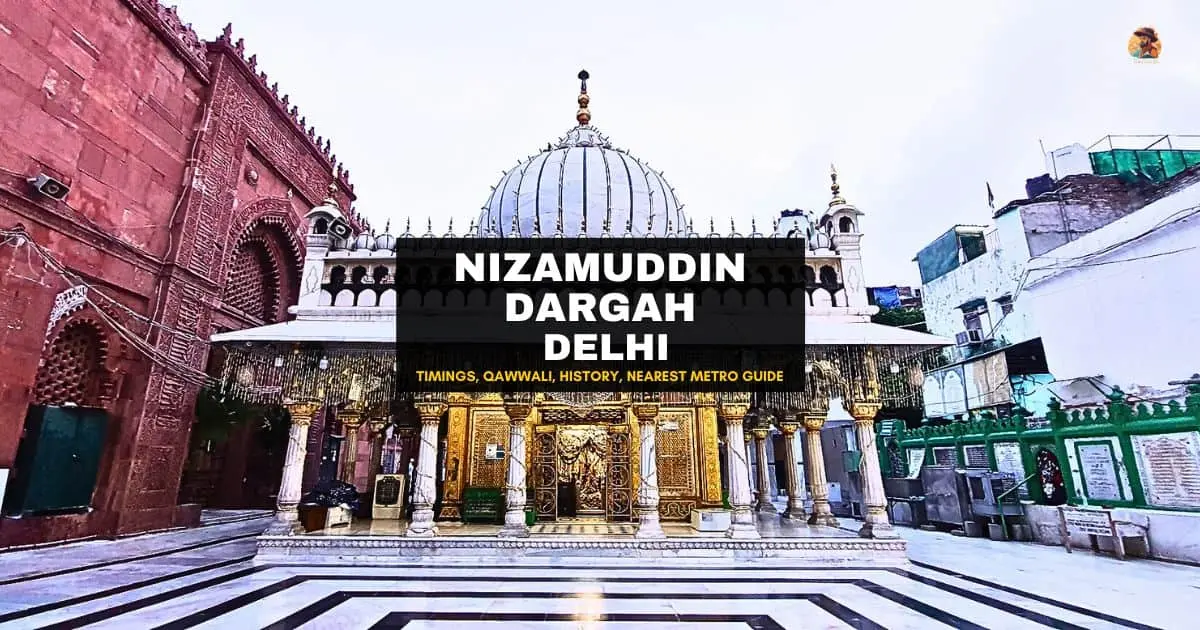
Nizamuddin Dargah, Delhi, was the kind of place where I stopped walking fast. The lane was narrow, crowded, and alive with smells of roses, fried kebabs, and incense. A man nudged a basket of marigolds towards me, a little boy tugged my kurta for coins, and a qawwal’s voice cracked in the distance as he tuned his harmonium. I knew I had reached a different world inside Delhi.
When I stepped into the courtyard of Hazrat Nizamuddin Auliya’s shrine, the city’s noise faded. All I could hear was clapping, the rise of the harmonium, and voices joining in chorus. For a moment, it felt less like music and more like a heartbeat running through the crowd. I sat on the cold stone floor. Women placed rose petals gently on the shrine. Men tied red threads with quiet faith. Children ran past Amir Khusrau’s grave, their laughter mixing with prayers.
For me, this Dargah was not just a matter of history or faith. It was a reminder of how Delhi carries both chaos and silence together. In this guide, I will share my own experience at the Nizamuddin Dargah in Delhi — the timings, how to reach it by metro, the history, and why the qawwali here makes you feel both small and infinite at the same time.
Why Visit Nizamuddin Dargah in Delhi?

The first time I entered Dargah Gali, I felt lost. Flower sellers blocked my way with baskets of roses, kids tugged at my kurta for coins, and a man almost brushed me aside while carrying a big chaddar on his head. For a moment, I thought, “Yeh jagah toh sirf bheed hai.” But then the sound of clapping and harmonium reached my ears, and I just kept walking in.
Inside, the mood changed completely. Hazrat Nizamuddin Auliya’s white tomb glowed under the lights, qawwals sang with all their heart, and people from every background sat together on the same floor. Near Amir Khusrau’s grave, children were laughing as they threw rose petals, while an old man wiped his tears quietly in one corner.
That mix of devotion, music, and everyday life is what makes this Dargah special. You do not need to know Urdu or Persian to feel the power of qawwali. You just sit there, and slowly the noise inside your own head begins to quieten down. That is why I tell anyone visiting Delhi: if you want to feel the city’s soul, come here once.
Nizamuddin Dargah Delhi Location & How to Reach
The Dargah is located at Boali Gate Road, Nizamuddin West, Delhi. The lanes are narrow and lively, filled with food stalls and flower shops, so you will always have to walk the last 200–300 meters.
🚇 Nearest Metro to Nizamuddin Dargah
- Hazrat Nizamuddin Metro (Pink Line): about 1 km away
- JLN Stadium Metro (Violet Line): about 1.5 km away
I usually prefer the Hazrat Nizamuddin Metro. The moment you come out, rickshaw drivers surround you asking, “Dargah chalna hai?” It is a short ride, and they drop you right near the gali entrance.
🛤️ Nizamuddin Dargah Metro Route
- From Connaught Place (Rajiv Chowk): Violet Line → Get down at JLN Stadium → 10 min auto ride.
- From Noida or East Delhi: Pink Line → Hazrat Nizamuddin Metro → Walk or take an e-rickshaw.
- From Gurgaon (Huda City Centre): Yellow Line till Central Secretariat → Switch to Violet Line → JLN Stadium.
- From Kashmiri Gate: Violet Line direct → JLN Stadium.
🚉 By Train or Road
- Hazrat Nizamuddin Railway Station is only 2 km away.
- Autos, cabs, and e-rickshaws drop you at Nizamuddin Basti. From there, just follow the flower stalls into Dargah Gali.
📌 Travel Tip: You will know you are close when the smell of kebabs mixes with the fragrance of incense. That first whiff is unforgettable.
Nizamuddin Dargah Delhi Timings & Best Time to Visit
When I first reached Nizamuddin Dargah in the morning, the gali felt calm. Shops were half-open, flower sellers were still arranging baskets, and a faint smell of incense mixed with wet stone after the wash. By evening, the same place had completely changed — bright lights, kebabs sizzling on tandoors, and a steady stream of people heading inside with chaddars.
The Dargah usually opens around 5:00 AM with the first call for prayer and closes by 10:30 PM. You can go any day, but each time of day has its own mood.
⏰ Hazrat Nizamuddin Auliya Dargah Timings Today
- Morning (5:00 AM – 9:00 AM): Peaceful, almost empty. A good time if you just want to sit in silence.
- Afternoon (12:00 – 4:00 PM): Quieter, though you will find people tying threads or offering flowers.
- Evening (after 6:00 PM): Gets crowded, qawwals begin tuning their harmoniums, and the vibe turns festive.
- Night (till 10:30 PM): The courtyard feels more intimate, with smaller groups praying or singing softly.
📅 Best Days to Visit (Thursday, Urs, Basant Panchami)
- Thursday evenings: After Maghrib prayers, the courtyard bursts with qawwali. I remember squeezing in with a crowd so thick that even standing felt impossible, but once the clapping started, nobody cared.
- Urs (Rabi II month): The death anniversary of Hazrat Nizamuddin Auliya. The Dargah glows with lights, and devotees tie colorful threads at the gate. I once saw a man whisper his wish into a flower before placing it on the tomb.
- Ramadan evenings: At iftar, strangers pass dates, water, and biryani around. One evening, an old man handed me a sweet without even asking my name. That small kindness stays with me.
- Basant Panchami: Everyone wears yellow. Devotees bring mustard flowers, and qawwals sing songs written by Amir Khusrau centuries ago. The Dargah feels like spring has walked inside.
📌 Travel Tip: Go in the morning for peace, or on Thursday night if you want to feel the heartbeat of Delhi.
Qawwali Nights at Nizamuddin Dargah
The first qawwali night I attended here was unforgettable. I sat barefoot on the cold marble floor, pressed between two college boys on one side and an old couple on the other. The harmonium started with a slow note, followed by the sharp clap of hands. Within minutes, the whole crowd was swaying together, some closing their eyes, some singing along.
Qawwali usually happens every Thursday evening after Maghrib prayers (around 7:30 PM onwards). Sometimes the music continues deep into the night. One group finishes, and another begins with fresh energy. There are no seats, no tickets — you just sit wherever you find space.
Many of the songs are linked to Amir Khusrau, the poet and disciple of Hazrat Nizamuddin Auliya. When the qawwals sing his verses, the sound seems to bounce off the marble walls and rise straight into the sky.
What struck me the most was how differently people reacted. One young boy was recording on his phone, while an old man next to me was quietly wiping his tears. I forgot the city outside. For those minutes, Delhi’s honking traffic felt far away — only the music stayed.
📌 Tips for Visitors:
- Arrive early on Thursday evenings; the courtyard fills fast.
- Carry a scarf or dupatta to cover your head.
- Keep a water bottle handy, as it can get crowded and warm.
- Do not treat it like a concert; just listen and let the music work on you.
History of Hazrat Nizamuddin Auliya & the Dargah

The history of Nizamuddin Dargah is not just about dates or dynasties; it is about Delhi’s soul. Hazrat Nizamuddin Auliya R.A, one of the most loved Sufi saints, lived in the 13th–14th century. His life was marked by simplicity and his belief that serving people was the truest form of worship. That is why even today, the Dargah never turns anyone away.
Whenever I sit near his shrine, I feel the weight of centuries of prayers around me. The air itself feels heavier, almost soaked with devotion. And then, just a few steps away, lies the tomb of Amir Khusrau, his disciple and poet. One evening, I sat quietly there while qawwals sang his couplets. The crowd was mixed — some people recording on phones, some softly crying, some just smiling. It felt as if Khusrau’s words were still alive, carried forward through the voices of strangers.
Over time, the Dargah grew into a whole complex. The marble shrine of Hazrat Nizamuddin became the center, and around it, you now find:
- Jamat Khana Masjid – among the earliest mosques in Delhi
- Baoli (stepwell) – built for travelers and the community to draw water
- Chausath Khamba – a tomb with 64 pillars, glowing white in the evenings
For me, this history is less about marble and stone and more about the constant flow of people. Every time I visit, I see new faces but the same devotion, and that is what keeps the story of this Sufi saint in Delhi alive.
What to Expect Inside Nizamuddin Dargah
The journey begins in Dargah Gali. The lane is so narrow that sometimes two rickshaws cannot cross at once. Both sides are lined with stalls selling rose petals and shiny green chaddars embroidered with golden threads. Shopkeepers keep calling out, “Phool le lo, chaddar chadha do,” while children weave through the crowd carrying trays of incense. The noise can feel too much at first, but by the time you reach the gate, the fragrance of roses and burning agarwood tells you that you are in the right place.
Inside the courtyard, I always notice how differently people express their faith. Some close their eyes and stay silent for hours. Others tie red threads on the marble screens and whisper their wishes. A few just sit with families, passing around prasad or food. The scent of incense, rose petals underfoot, and low prayers create a feeling that lingers long after you leave.
Typical sights and rituals you will come across:
- Devotees placing flowers and chaddars on the tomb
- Bright red threads tied to marble screens with whispered wishes
- Langar (free food) is offered by volunteers at different hours
- Children playing around Amir Khusrau’s grave while elders chant nearby
- Qawwali rehearsals are warming up in the evenings
During Ramadan, the courtyard changes completely at iftar. I once sat cross-legged on the floor when volunteers passed plates of biryani and dates down the rows. I did not know the person sitting next to me, but he shared his water with me as if we had come together. That is the kind of warmth the Dargah gives you.
Keep your head covered, remove shoes at the entrance, and carry some small change if you want to contribute. But more than that, carry patience — the crowd moves slowly, and you are meant to slow down with it.
Visitor Information – Dress Code, Safety & Entry Rules
On my first visit, I saw a group of foreign tourists sitting quietly near the courtyard wall. Nobody looked at them differently. They clapped during qawwali, shared prasad with locals, and blended in naturally. That moment told me something important — the Dargah is open for everyone, no matter who you are.
There are a few unspoken rules that make the visit smoother.
- Dress Code: Modest clothing is expected. Both men and women should cover their heads. Once, I forgot my scarf, and a shopkeeper handed me a plain dupatta with a smile. That small gesture reminded me how seriously the head covering is taken here.
- Photography: Phones are fine, but DSLRs often face restrictions inside the sanctum. I once saw a guard gently tap a man on the shoulder and ask him to put his camera away.
- Crowds: On Thursday evenings, the crowd can feel like a single wave. I remember being stuck shoulder to shoulder and realising you cannot rush here, but you just move with the flow. Mornings, on the other hand, feel spacious and calm.
- For Women: The place is safe, but mornings and afternoons are more comfortable if visiting alone.
- For Foreign Tourists: Keep some small cash for offerings or langar. Locals may strike up conversations out of curiosity — most of mine ended with a smile or a quick blessing.
And yes, there is no entry fee. Everyone, rich or poor, local or outsider, walks through the same gate. That equality is part of what makes this place so powerful.
✅ Do / Don’t – Nizamuddin Dargah Visitor Tips
Do:
- Cover your head with a scarf or dupatta and wear modest clothes.
- Sit quietly and keep your phone on silent during qawwali.
- Remove shoes before entering the courtyard.
- Move slowly in crowds, especially with elders or children.
Don’t:
- Do not carry DSLRs or professional cameras inside the sanctum (they are usually restricted).
- Avoid taking selfies near the tomb or prayer mats.
- Do not push or speak loudly in the crowd; stay calm and respectful.
Festivals & Special Events at Nizamuddin Dargah
Festivals change the rhythm of Nizamuddin Dargah completely. The same courtyard where you might find silence in the morning turns into a sea of devotion during these events.
- Urs of Hazrat Nizamuddin Auliya (Rabi II): On this night, the shrine glows with lamps. I once arrived late and had to sit outside the gate. Even from there, I could hear the qawwali mixing with the crackle of oil lamps and the hum of thousands of voices praying together.
- Basant Panchami: The courtyard turns yellow with mustard flowers. I remember brushing past people whose dupattas smelled of fresh marigolds. Qawwals sang Amir Khusrau’s Basant songs, and for a moment it felt like spring had seeped into the marble walls.
- Ramadan Iftar Gatherings: At sunset, the courtyard becomes a dining hall. Long rows stretch out, plates of biryani and dates moving hand to hand. One evening, a stranger offered me his water bottle before drinking it himself. That single act captured the spirit of Ramadan at Nizamuddin.
Each festival has its own flavor. Urs is intense and spiritual, Basant feels festive and full of color, and Ramadan evenings wrap you in a warmth that makes even strangers feel like family.
Food & Stay Near Nizamuddin Dargah
Stepping out of the Dargah lane, the smell of kebabs mixes with the sweetness of fresh jalebis. One evening, I stood at a stall, juggling a plate of seekh kebabs wrapped in rumali roti. The meat was smoky and juicy, and the oil ran down my fingers faster than I could wipe it.
Food spots to try nearby:
- Karim’s: Famous for mutton korma and kebabs, always buzzing with families.
- Kit Care Kebab Corner: Tiny stall, fiery seekh kebabs with rumali roti.
- Zaika-E-Nizamuddin: Homestyle biryani run by women of the basti.
- Street stalls: Samosas that sting your tongue, jalebis dripping syrup, sharbat in tall steel glasses.
Staying nearby makes life easier if you want to catch late-night qawwalis or early morning prayers. I once booked a budget hotel near Hazrat Nizamuddin station — trains kept me awake, but walking to the Dargah at sunrise was priceless. Another time, I stayed in Lodhi Colony near Lodhi Garden Walk Experience — calm, green, and perfect after the crowded courtyard.
Stay options:
- Budget hotels near Hazrat Nizamuddin Station — noisy but closest.
- Mid-range stays in Jangpura or Lajpat Nagar — lively, food-filled neighborhoods.
- Luxury hotels in Lodhi Colony or near India Habitat Centre — quiet, green, and a short drive.
Nearby Attractions Around Nizamuddin Dargah
What I love about Nizamuddin is that history surrounds you the moment you step out. After the shrine, I often wander into nearby lanes, and each turn feels like another layer of Delhi unfolding.
Places worth visiting:
- Humayun’s Tomb: A UNESCO gem, glowing red at sunset. After rain, the gardens smell of wet earth, and parrots swoop across the sky.
- Chausath Khamba: White marble tomb with 64 pillars. The echo of my footsteps once made me stop mid-walk just to listen.
- Amir Khusrau’s Tomb: Inside the Dargah itself. Hearing qawwals tuning their harmonium here felt like catching poetry being born.
- Ghalib Academy & Museum: A short walk away, showcasing Mirza Ghalib’s letters and couplets. Reading them felt like Delhi whispering its poetry.
- Nizamuddin Basti Heritage Walk: Narrow lanes, old baolis, hidden mosques, and food stalls — a living museum buzzing with voices and aromas.
Walking through these places after the Dargah feels like moving between devotion, poetry, and history — all within the same neighborhood. After visiting Nizamuddin Dargah, you can explore more peaceful places from my list of Popular Temples in Delhi.
Nizamuddin Dargah for Foreign Tourists
The first time I saw foreign tourists at Nizamuddin Dargah in Delhi, they looked a little lost. But once the qawwali began, they clapped along shyly, and within minutes, they were smiling just like everyone else. That is the real magic of Nizamuddin Dargah Delhi — it welcomes everyone without asking who you are.
A few things can make the visit smoother:
- Qawwali experience: Thursday evenings after Maghrib are the best. If it is crowded, sit near the back. I once guided a couple from Spain to a corner spot, and they told me later it was the highlight of their Delhi trip.
- Navigation: Use Google Maps. The nearest metros are JLN Stadium (Violet Line) and Hazrat Nizamuddin (Pink Line). An auto-rickshaw from either station takes 5–10 minutes.
- Essentials: Carry some cash for offerings, a water bottle, and tissues for toilets.
- Dress code: Modest clothes and a head covering are expected. Even a scarf or handkerchief works.
- Cultural do’s & don’ts: Avoid stepping on prayer mats, do not click photos of people without asking, and keep your phone silent inside the sanctum.
With these basics, you will blend in naturally and feel the warmth that makes this shrine unforgettable.
My Experience & Final Word
One Thursday evening at Nizamuddin Dargah Delhi, I sat on the cool marble floor, knees pressed to my chest as qawwals began singing. The harmonium and claps echoed through the courtyard, and for a moment, I forgot the chaos of Delhi waiting outside. My legs went numb from sitting too long, yet I did not want to move. I wanted to stay in that sound, in that silence between the notes — where faith, music, and the city’s heartbeat become one.
For me, Nizamuddin Dargah Delhi is not just a Dargah. It is Delhi’s heartbeat — where music meets faith, and strangers become part of the same rhythm. If you ever visit, sit still for a while, close your eyes, and let the qawwali sink in. And when you do, share your experience in the comments. I would love to hear how Nizamuddin touched your journey.
FAQs About Nizamuddin Dargah Delhi
The nearest is the Hazrat Nizamuddin Metro Station (Pink Line), about a 10–12 minute walk. Another convenient option is JLN Stadium Metro (Violet Line), from where you can take a short auto or rickshaw ride.
Qawwalis are performed every Thursday evening after Maghrib (sunset) prayers. Arriving around 7:00–7:30 pm helps to find seating before the crowd gathers.
Yes, women can visit the shrine. It is recommended to dress modestly and cover the head with a scarf or dupatta inside the sacred premises.
Mobile photography is generally allowed in the outer courtyard. However, DSLR or professional cameras are not permitted inside the sanctum, and visitors may be politely requested to avoid using them.
This shrine is dedicated to Hazrat Nizamuddin Auliya, one of India’s most revered Sufi saints. The Dargah is famous for its soulful qawwalis, spiritual atmosphere, centuries‑old Mughal‑era architecture, and its role in Sufi culture.
Yes, the area is considered safe, especially on Thursday evenings, when large crowds of families and devotees gather. As in any busy market area, it is advisable to keep an eye on personal belongings.

Hi, I am Manoj Kumar, a travel researcher and SEO content expert writing for Trip Guru Go, focused on Delhi and nearby travel destinations.
Being from Delhi NCR, I understand the travel preferences, routes, budgets, and experiences that travelers from this region actually look for. Every article I write is backed by local insights, real traveler experiences and detailed research to provide accurate and useful travel information.