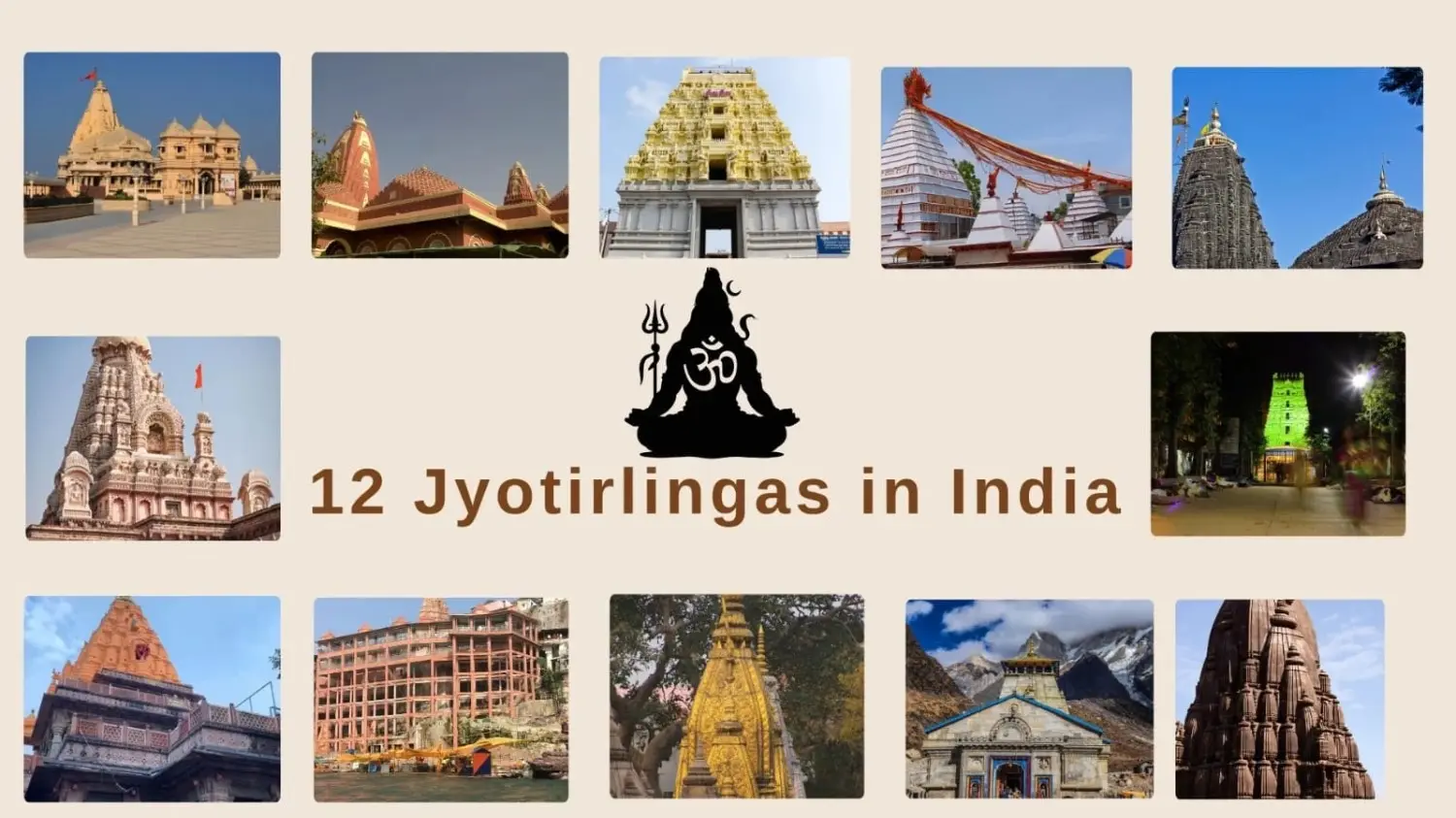
The 12 Jyotirlinga in India are revered pilgrimage sites in Hinduism dedicated to Lord Shiva. All across India, representing the divine manifestation of Shiva as an infinite pillar of cosmic light.
Located in different parts of India, from the snow-capped peaks of Kedarnath to the coastal shores, the twelve sacred shrines are considered the most holy and auspicious in Hinduism.
Anchoring the nation’s spiritual geography and cultural heritage, these holy places attract millions of devotees nationwide.
Holding immense spiritual significance; believed that visiting these holy shrines cleanses all the sins of visitors and brings salvation for them. Among all of them, Kedarnath is the most visited shrine through Kedarnath tour package.
Explore more about the 12 Jyotirlinga of Shiva in India, including their significance, best route to cover the pilgrimage, and travel tips.
12 Jyotirlinga Name & Place (Location)
| Temple Name | District (Region) | State |
| Somnath | Prabhas Patan area of Gir Somnath district | Gujarat |
| Mallikarjuna | Srisailam | Andhra Pradesh |
| Mahakaleshwar | Ujjain | Madhya Pradesh |
| Omkareshwar | Khandwa district | Madhya Pradesh |
| Nageshwar | Dwarka, | Gujarat |
| Kedarnath | Rudraprayag | Uttarakhand |
| Bhimashankar | Pune | Maharashtra |
| Kashi Vishwanath | Varanasi | Uttar Pradesh |
| Baidyanath | Deoghar. | Jharkhand |
| Ramnathaswamy | Rameshwaram | Tamil Nadu |
| Trimbakeshwar | Nashik | Maharashtra |
| Grishneshwar | Ellora Caves in Chhatrapati Sambhaji Nagar | Maharashtra |
About 12 Jyotirlinga of Shiva
The 12 Jyotirlinga in India are highly sacred shrines of Lord Shiva, known as the Dwadash Jyotirlinga Yatra. Mentioned in ancient texts like the Shiva Purana, these self-manifested pillars of divine light are renowned as a path to spiritual liberation (Moksha).
The word “Jyotirlinga” derives from two Sanskrit words: “Jyoti” (light) & “Linga” (symbol representing Shiva), which means an infinite column of radiant light.
Mythological Story & Significance
According to Hindu mythology, Lord Brahma and Lord Vishnu argued over who is the supreme deity; their fight could threaten world peace. To resolve this dispute, Lord Shiva created a limitless, fierce light with no start or end.
Challenged both deities, whose source would be worshiped as the supreme deity of the universe.
Vishnu went downwards to find the base, while Brahma flew upward to find its top. Neither found it; Vishnu accepted his failure, and Brahma lied that he found the top and presented the Ketki Pushp to prove his lie.
To expose Lord Brahma, Shiva appeared in a fierce form and showed his supremacy on earth, leading to the origin of sacred shrines.
Unlike the normal idols in temples made by humans, these 12 Jyotirlinga in India are self-manifested (swayambhu Shivlinga).
All 12 Jyotirlinga in India: Geographic Distribution
Below is an explanation of all 12 Jyotirlinga temples based on geographical distribution (region-based), spanning across 8 Indian states.
Northern India (Kashi Vishwanath & Kedarnath)
Kashi Vishwanath Jyotirlinga
Situated on the western bank of the Holy Ganga River, Shri Kashi Vishwanath Temple is a revered Hindu temple in Varanasi (Banaras) in Uttar Pradesh.
As one of the sacred 12 Jyotirlinga in India, the temple holds great importance in Hinduism, featuring a stunning gold-plated dome. It’s renowned for its revered ghats such as Manikarnika Ghat and Daswamedh Ghat
- Location: Varanasi city, Uttar Pradesh
- How to reach it: By air via Lal Bahadur Shastri Airport, by train via Varanasi Junction & by road via Varanasi city, known as Banaras.
- Best time to visit: October to March & Shravan months (July-August)
- Highlights: Temple architecture with golden spire, temple corridor, evening Ganga Aarti & sacred ghats.
Kedarnath Jyotirlinga
Nestled in the lap of the Garhwal Himalayas of Uttarakhand, Kedarnath Jyotirlinga is one of the most revered Shiva shrines.
Located in the Rudraprayag district at an altitude of 11,755 feet along the Mandakini riverbank, it is the highest Jyotirlinga among the 12 and tied to the legend of the Mahabharata.
It is believed to be built by the Pandavas, and it is reachable via a 16 km trek from the Gaurikund base point. The surrounding scenery and divine energy of the site attract millions of devotees across the country.
- Location: Rudraprayag district of Uttarakhand
- How to reach it: By air via Dehradun airport, by train via Haridwar & Rishikesh, or by road via Uttarakhand major cities. The final stretch requires a trek to reach the shrine.
- Best time to visit: May to October; the temple is open & the weather is pleasant
- Highlights: View of snow-capped Himalayan peaks and ancient temples like Bhairavnath Temple & Rudra Cave.
Western India (Somnath, Nageshwar, Bhimashankar, Trimbakeshwar, & Grishneshwar)
Shree Somnath Jyotirlinga
Located in the Prabhas Patan area of Gir Somnath district of Gujarat along the western coast, Sri Somnath temple is considered the very first Jyotirlinga on the traditional route to the 12 Jyotirlinga in India.
It is believed the temple was built by the moon god Chandrama; it was destroyed and rebuilt multiple times in its history. Symbolizes powerful resilience and its overlooking location on the Arabian Sea.
It is also famous for its evening sound and light show, which represents temple legends and history on a screen.
- Location: Gir Somnath district of Gujarat
- How to reach it: By air via Rajkot or Diu airport, by train via Vairaval Junction, by road via Rajkot city.
- Best time to visit: October to March for a pleasurable experience
- Highlights: Sound-light show, Bhalka tirth dham, & Baan stambh
Nageshwar Jyotirlinga
Located between Dwarka city and Beyt Dwarka island in Gujarat, Nageshwar Jyotirlinga is one of the prominent Hindu temples. The deity (Lord Shiva) is worshipped here as the Lord of serpent means “Nageshwar.”
It is also famous for its 82-foot-tall Shiva statue; devotees often visit here to seek blessings and perform special pujas like Kaal Sarp Dosh.
- Location: Dwarka district, Gujarat
- How to reach it: By air via Porbandar Airport, by train via Dwarka Railway Station, by road via Dwarka city center.
- Best time to visit: October to March for a pleasant travel experience
- Highlights: Large Shiva statue, nearby Dwarkadish Temple, & Gomti Ghat
Bhimashankar Jyotirlinga
Nestled in the Sahyadri hills of Maharashtra near Pune district, Bhimashankar is a sacred Hindu shrine among the 12 Jyotirlinga in India.
Surrounded by lush green peaks and dense forest, the temple is known for its natural beauty and spiritual resilience.
- Location: Bhorgiri village, Pune district, Maharashtra
- How to reach it: By air via Pune Airport, by train via Pune Junction & by road via Pune city.
- Best time to visit: October to March & June to September
- Highlights: Bhimashankar Wildlife Sanctuary & sacred Kunds
Trimbakeshwar Jyotirlinga
Located in the Nashik district of Maharashtra, Trimbakeshwar Jyotirlinga is a revered shrine famous for its unique three-faced linga, which represents the trinity Brahma, Vishnu, and Mahesha (Shiva).
The temple is believed to have been built by Pandit Peshwa Balaji Rao, featuring dark basalt stone. This shrine is widely popular for ancient Vedic traditions and puja, like Kaal Sarp Dosh.
- Location: Nashik District of Maharashtra
- How to reach it: By air via Mumbai Airport, by train via Nashik Railway Station & by road via Nashik city.
- Best time to visit: October to March & June to September
- Highlights: Brahmagiri hills, Kushwarta Kund architecture, & the main ancient Tribakeshwar temple.
Grishneshwar Jyotirlinga
The Grishneshwar Mahadev temple is located in the Verul village of Maharashtra near the Ellora Caves. Considered the final and twelfth Jyotirlinga on the traditional clockwise pilgrimage route of 12 Jyotirlinga in India.
The site holds immense spiritual significance, where Lord Shiva appeared as cosmic energy to a devotee named Gushma.
Unlike the many Jyotirlinga not allow for Sparsh Darshan, in Grishneshwar pilgrims are allowed to get Sparsh Darshan of the Jyotirlinga and offer prayers to the deity.
- Location: Verul village near Ellora Caves, Maharashtra
- How to reach it: By air via Aurangabad airport or Chatrapati Shivaji airport, by train via Aurangabad railway station, by road via cities like Mumbai and Pune.
- Best time to visit: October to February
- Highlights: Ellora Caves & Daultabad fort
Central India (Mahakaleshwar & Omkareshwar)
Mahakaleshwar Jyotirlinga
Located in the ancient city of Ujjain, Madhya Pradesh, the Mahakaleshwar Jyotirlinga temple is a highly revered Hindu shrine.
Situated on the banks of the Kshipra River, the shrine is renowned for its powerful divine energy; it is the only temple among the 12 Jyotirlinga in India that faces south, known as Dakshinmukhi Jyotirlinga.
It represents Shiva as “Mahakaal,” meaning the Lord of time & death. It is famous for its divine Bhasma Aarti, massive corridor, and ancient temples like Kaal Bhairav, Sidhi Mata Mandir, and Gad Kalika temple.
- Location: Ujjain city of Madhya Pradesh
- How to reach it: By air via Ahilyabai Airport, by train via Ujjain Junction, & by road via Bhopal and Indore.
- Best time to visit: October to March & July-August for festivals
- Highlights: Sacred Daskahinmukhi Jyotirlinga; iconic Bhasma Aarti; ancient temples, like Kaal Bhairav; and the massive Mahakal Mahalok corridor.
Omkareshwar Jyotirlinga
Located on Mandhata island of the Narmada River in the Khandwa district of Madhya Pradesh, Omkareshwar temple is a sacred shrine of one of the 12 Jyotirlinga of Shiva. The island where the main temple is situated is uniquely shaped like the cosmic “Om.”
The temple is featured by its nearby attractions like Mamleshwar Temple, the main shrine, & sacred Ghats near the temple.
- Location: Khandwa district of Madhya Pradesh
- How to reach it: By air via Ahilyabai Holker Airport, by road via Omkareshwar Road Railway Station or Indore Junction, or by road via Indore and Khandwa.
- Best time to visit: October to March & July-August (Shravan months)
- Highlights: Mamleshwar Mahadev Mandir, Narmada River boating, and the Parikrama Path surrounding the island.
Eastern India (Baidyanath, Jharkhand)
Baidyanath Jyotirlinga
Baidyanath Jyotirlinga, also known as Baba Dham, is located in the Deoghar city of Jharkhand, within the Santhal Pargana division. It is famous for its divine blend of Jyotirlinga temple and Shakti Peetha; it symbolizes a powerful union of Shiva and Shakti.
It is represented by two shrines; one is the main Jyotirlinga temple, and the other is just adjacent and is dedicated to Devi Parvati, tied with a red thread, attracting many couples seeking blessings for marital harmony.
Shiva is worshipped here as a divine healer, linked to the legend of Ravana, whose pain and wound were healed by Shiva.
- Location: Deoghar in Jharkhand
- How to reach it: By air via Deoghar Airport, by train via Jasidih Junction & by road via Deoghar city.
- Best time to visit: October to March for a pleasurable experience & Srawan month (July-August) for Kanwar Mela.
- Highlights: Union of Jyotirlinga & Shakti Peeth, and ancient Naulakha temple
Rameshwaram Jyotirlinga
The Ramanathaswamy Temple, or Rameshwaram Jyotirlinga, is located on Pamban Island in the southern state of Tamil Nadu. It holds great significance and is tied to the legend of the epic Ramayana.
According to Hindu legend, Lord Rama consecrated a sacred Lingam here to worship Lord Shiva to seek the blessings before building a bridge to Lanka to rescue his wife, Goddess Sita.
The site features the world’s largest corridor, 22 holy theerthams (water tanks), and an ancient Panchmukhi temple, attracting devotees across the nation.
- Location: Rameswaram district of Tamil Nadu
- How to reach it: By air via Madurai Airport, By Train via Rameshwaram Railway Station & by road via cities like Chennai & Madurai in South India.
- Best time to visit: October to March peak season
- Highlights: Massive corridor, 22 teerthams, & Dhanushkodi
Mallikarjuna Jyotirlinga
Nestled at the top of the Nallamala hills on the banks of the Krishna River, Mallikarjuna Jyotirlinga is located in Srisailam, Andhra Pradesh. It is roughly 200 km from Hyderabad.
It is known as the “Kailash of the South” and uniquely serves as one of the revered twelve Jyotirlingas & a Shakti Peetha; it symbolizes the powerful union of Shiva and Parvati, who appeared as Arjuna and Mallika, giving it its name, “Mallikarjuna.”
- Location: Srisailam in Andhra Pradesh
- How to reach it: By air via Hyderabad Airport, by train via Marakpur Railway Station & by road via Hyderabad & Kurnool.
- Best time to visit: October to March & February for a festival glimpse
- Highlights: Unique blend of Jyotirlinga & Shakti peeths, Srisailam Dam, Patala Ganga spring.
Best Route To Cover All 12 Jyotirlinga of Shiva
The best route to cover all 12 Jyotirlinga in India in a single spiritual journey depends on convenience.
The most recommended route to cover all twelve circuits is to divide your pilgrimage into geographical regions and follow a comfortable flow that starts from North & East India and continues to Central & West India and ends at South India’s circuits.
Most recommended practical route:
Kedarnath → Kashi Vishwanath → Baidyanath → Omkareshwar → Mahakaleshwar → Grishneshwar → Bhimashankar → Trimbakeshwar → Somnath → Nageshwar → Mallikarjuna → Rameshwar
The journey takes around 15-20 days to cover all circuits smoothly with proper rest and exploration time.
Travel Tips for 12 Jyotirlinga Yatra
- Plan your trip wisely; check each circuit’s best time to visit and travel route conditions.
- Kedarnath is the only shrine that opens from May to October; ensure you plan your trip accordingly.
- Book VIP Darshan or Special Puja tickets online well in advance if you plan during peak season.
- Keep cash handy for local transit and local offerings.
- Carry valid ID proof during your whole journey; it may be asked at entry checkpoints.
- Follow temple etiquette; wear modest attire and respect the site.
Conclusion
The 12 Jyotirlinga in India are sacred holy shrines dedicated to Lord Shiva and spanning different parts of India. Each one has its unique mythological story and significance, which are mentioned in ancient Hindu texts.
Today, the surge of pilgrims to these holy shrines grows day by day among devotees, as visiting these circuits is considered a path of spiritual enlightenment that cleanses past sins and brings spiritual salvation.
FAQs
Where are the 12 jyotirlingas located?
The 12 Jyotirlinga of Shiva are located in different parts of India. These twelve holy shrines span over 8 states of India, whose names are:
- Somnath and Nageshwar in Gujarat
- Omkareshwar and Mahakaleshwar in Madhya Pradesh
- Kashi Vishwanath in Uttar Pradesh
- Baidyanath in Jharkhand
- Kedarnath in Uttarakhand
- Bhimashankar, Grishneshwar
- Trimbakeshwar in Maharashtra
- Rameshwaram in Tamil Nadu
- Mallikarjuna in Andhra Pradesh
Which Jyotirlinga is very powerful?
Well, all the twelve Jyotirlingas hold immense significance due to their spiritual power, but Mahakaleshwar is considered the most powerful among all twelve, as it is the only Jyotirlinga facing south (Dakshinmukhi) and represents the deity as the lord of time & death. It is renowned for its iconic and most powerful Bhasma Aarti, which free devotee from the fear of death.
What is the oldest Jyotirlinga?
Somnath is the oldest and primarily built Jyotirlinga, located in the Prabhas Patal area of Gujarat on the western coast of the Arabian Sea.
Which is the first Jyotirlinga to visit?
According to Hindu texts, Somnath is the very first Jyotirlinga to visit; considered the very first place where Lord Shiva appeared as a cosmic light form.
What happens if you visit all the Jyotirlingas?
As per Hindu traditions, pilgrims who complete the 12 Jyotirlinga yatra can be free from the cycle of rebirth, and the journey cleanses all the past sins of pilgrims and leads them to Moksha.
Apurv jain is a travel seo and content writer who specializes in creating well-researched and engaging travel content. His work focuses on destinations, itineraries, travel guides, and practical tips that help readers plan memorable and hassle-free journeys.